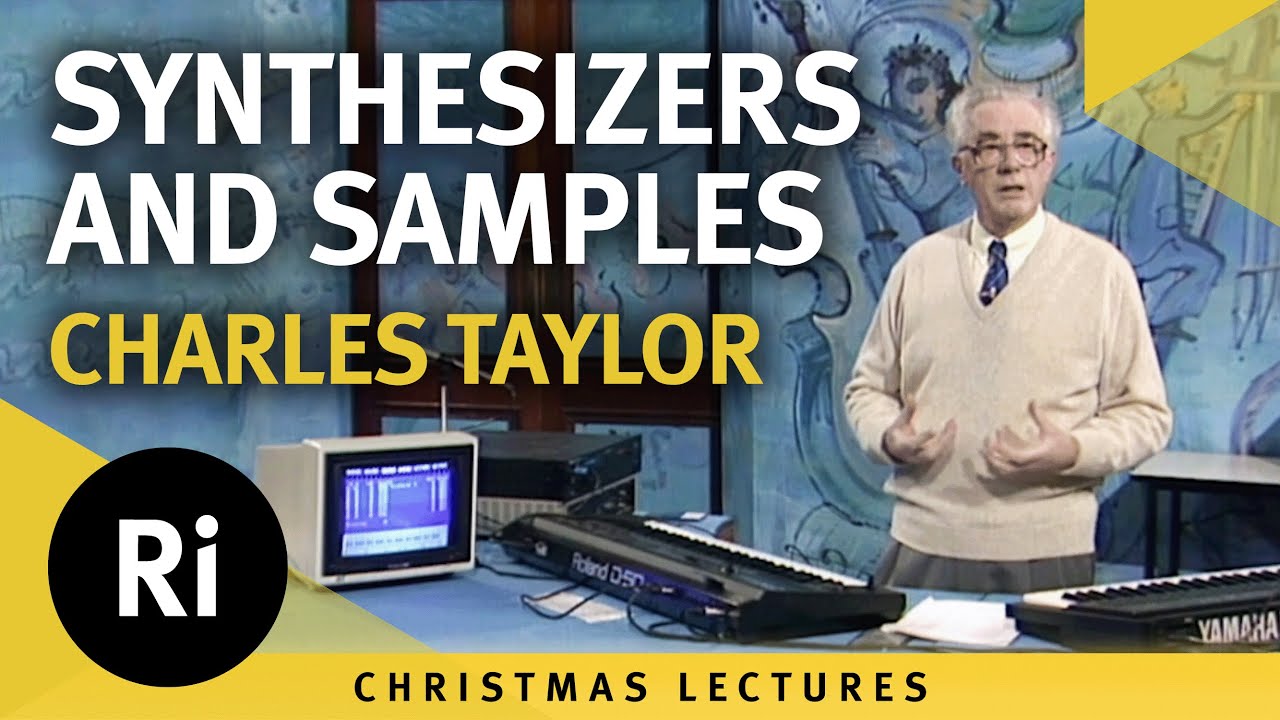
Scales, synthesizers and samples – Charles Taylor’s 1989 Christmas Lectures 5/5
In his final lecture, Charles Taylor explores electronic instruments and muses on whether they may one day replace traditional ones.
Watch all the lectures in this series here: https://www.youtube.com/playlist?list=PLbnrZHfNEDZywm9-OxvqPpP8RnE4dQnXY
Watch our newest Christmas lectures here: https://www.youtube.com/playlist?list=PLbnrZHfNEDZyQJZLPMjwEoOLdkFBLU2m1
This was recorded on 5 Dec 1989.
--
This year marks 200 years of the Royal Institution Christmas Lectures — a world famous series showcasing science, curiosity, and mind-blowing demos, and started by the legendary Michael Faraday himself. To celebrate, we're unlocking the archive. Every Saturday, we’ll upload a classic lecture to our YouTube channel — some not seen since they aired on TV. Sign up as a Science Supporter and get early access here: https://www.youtube.com/channel/UCYeF244yNGuFefuFKqxIAXw/join
--
From the 1989 programme notes:
Harpsichords and spinets are mechanised members of the plucked string family and it is well known that the major problem with these instruments is that it is difficult to make the sound vary in loudness. This lecture will explore how we overcome this problem leading to the feat of mechanical engineering that is the modern piano.
The origin of musical scales is particularly fascinating. But a problem arises with keyboard instruments that it is impossible to play scales in all keys exactly in tune. Fortunately, the synthesizers forming the main part of this lecture provide us with a convenient way to demonstrate the problem and its solution.
The world of synthesizers and computers has developed explosively in the last few years. This lecture will explore this extraordinary world using resources from one of the most modern electronic music studios in the world, the BBC Radiophonic Workshop.
We aim to answer many of the questions that arise in considering the partnership between science and music, but there are some difficult ones that remain. Will synthesizers replace conventional instruments? Will computers replace composers and performers? Can science explain the "shiver in the spine" that many of us feel when certain pieces of music are heard? And what totally new questions will be generated as a result of the scientific exploration of music?
--
About the 1989 CHRISTMAS LECTURES
Science and music are often treated as separate subjects yet large numbers of scientists are passionate about music. Science is sometimes described as the process of asking questions about the world around us and in this series of lectures, we shall be asking scientific questions about many different aspects of music, starting with the most difficult of all… ‘What is Music?’
It is a fact that every sound is produced by changing the pressure of the air by a small amount. These pressure changes travel as waves to our ears and when they are perceived by the ear-brain system, they become what we call sound and music. We shall explore the basic science involved in this journey including how musical instruments make pressure changes and the factors that affect sound quality, both from the craftsmanship of the instrument to the skill of the performer.
The ear-brain system has a profound effect on our perception of music and these lectures will consider this alongside how the technology of instruments in different cultures have influenced the development of music.
These lectures will include demonstrations from over 100 years ago, using much of the original apparatus which has survived at the Royal Institution. While many of the demonstrations in this lecture series may appear to be quite objective, it is necessary to remind ourselves that we are dealing with very subjective phenomena. The experience we call music can on be understood properly if we bring the measurements and observations out of the lab and apply them in the real world of performance and listening.
Find out more about the CHRISTMAS LECTURES here: https://www.rigb.org/christmas-lectures
---
Join this channel to get access to perks:
https://www.youtube.com/channel/UCYeF244yNGuFefuFKqxIAXw/join
Subscribe for regular science videos: http://bit.ly/RiSubscRibe
The Ri is on Twitter: http://twitter.com/ri_science
and Facebook: http://www.facebook.com/royalinstitution
and TikTok: https://www.tiktok.com/@ri_science
Listen to the Ri podcast: https://podcasters.spotify.com/pod/show/ri-science-podcast
Donate to the RI and help us bring you more lectures: https://www.rigb.org/support-us/donate-ri
Our editorial policy: https://www.rigb.org/editing-ri-talks-and-moderating-comments
Subscribe for the latest science videos: http://bit.ly/RiNewsletter
Product links on this page may be affiliate links which means it won't cost you any extra but we may earn a small commission if you decide to purchase through the link.
Watch all the lectures in this series here: https://www.youtube.com/playlist?list=PLbnrZHfNEDZywm9-OxvqPpP8RnE4dQnXY
Watch our newest Christmas lectures here: https://www.youtube.com/playlist?list=PLbnrZHfNEDZyQJZLPMjwEoOLdkFBLU2m1
This was recorded on 5 Dec 1989.
--
This year marks 200 years of the Royal Institution Christmas Lectures — a world famous series showcasing science, curiosity, and mind-blowing demos, and started by the legendary Michael Faraday himself. To celebrate, we're unlocking the archive. Every Saturday, we’ll upload a classic lecture to our YouTube channel — some not seen since they aired on TV. Sign up as a Science Supporter and get early access here: https://www.youtube.com/channel/UCYeF244yNGuFefuFKqxIAXw/join
--
From the 1989 programme notes:
Harpsichords and spinets are mechanised members of the plucked string family and it is well known that the major problem with these instruments is that it is difficult to make the sound vary in loudness. This lecture will explore how we overcome this problem leading to the feat of mechanical engineering that is the modern piano.
The origin of musical scales is particularly fascinating. But a problem arises with keyboard instruments that it is impossible to play scales in all keys exactly in tune. Fortunately, the synthesizers forming the main part of this lecture provide us with a convenient way to demonstrate the problem and its solution.
The world of synthesizers and computers has developed explosively in the last few years. This lecture will explore this extraordinary world using resources from one of the most modern electronic music studios in the world, the BBC Radiophonic Workshop.
We aim to answer many of the questions that arise in considering the partnership between science and music, but there are some difficult ones that remain. Will synthesizers replace conventional instruments? Will computers replace composers and performers? Can science explain the "shiver in the spine" that many of us feel when certain pieces of music are heard? And what totally new questions will be generated as a result of the scientific exploration of music?
--
About the 1989 CHRISTMAS LECTURES
Science and music are often treated as separate subjects yet large numbers of scientists are passionate about music. Science is sometimes described as the process of asking questions about the world around us and in this series of lectures, we shall be asking scientific questions about many different aspects of music, starting with the most difficult of all… ‘What is Music?’
It is a fact that every sound is produced by changing the pressure of the air by a small amount. These pressure changes travel as waves to our ears and when they are perceived by the ear-brain system, they become what we call sound and music. We shall explore the basic science involved in this journey including how musical instruments make pressure changes and the factors that affect sound quality, both from the craftsmanship of the instrument to the skill of the performer.
The ear-brain system has a profound effect on our perception of music and these lectures will consider this alongside how the technology of instruments in different cultures have influenced the development of music.
These lectures will include demonstrations from over 100 years ago, using much of the original apparatus which has survived at the Royal Institution. While many of the demonstrations in this lecture series may appear to be quite objective, it is necessary to remind ourselves that we are dealing with very subjective phenomena. The experience we call music can on be understood properly if we bring the measurements and observations out of the lab and apply them in the real world of performance and listening.
Find out more about the CHRISTMAS LECTURES here: https://www.rigb.org/christmas-lectures
---
Join this channel to get access to perks:
https://www.youtube.com/channel/UCYeF244yNGuFefuFKqxIAXw/join
Subscribe for regular science videos: http://bit.ly/RiSubscRibe
The Ri is on Twitter: http://twitter.com/ri_science
and Facebook: http://www.facebook.com/royalinstitution
and TikTok: https://www.tiktok.com/@ri_science
Listen to the Ri podcast: https://podcasters.spotify.com/pod/show/ri-science-podcast
Donate to the RI and help us bring you more lectures: https://www.rigb.org/support-us/donate-ri
Our editorial policy: https://www.rigb.org/editing-ri-talks-and-moderating-comments
Subscribe for the latest science videos: http://bit.ly/RiNewsletter
Product links on this page may be affiliate links which means it won't cost you any extra but we may earn a small commission if you decide to purchase through the link.

The Royal Institution
Videos to make you think more deeply about science. Explosive short films, full length talks from the world’s leading scientists and writers, and videos to challenge the way you look at the world.
The Royal Institution is a 200 year old independent chari...
Science, strings and symphonies – Charles Taylor’s 1989 Christmas Lectures 3/5
The Royal Institution
Did Kathleen Lonsdale deserve a Nobel Prize? Her groundbreaking work explained
The Royal Institution