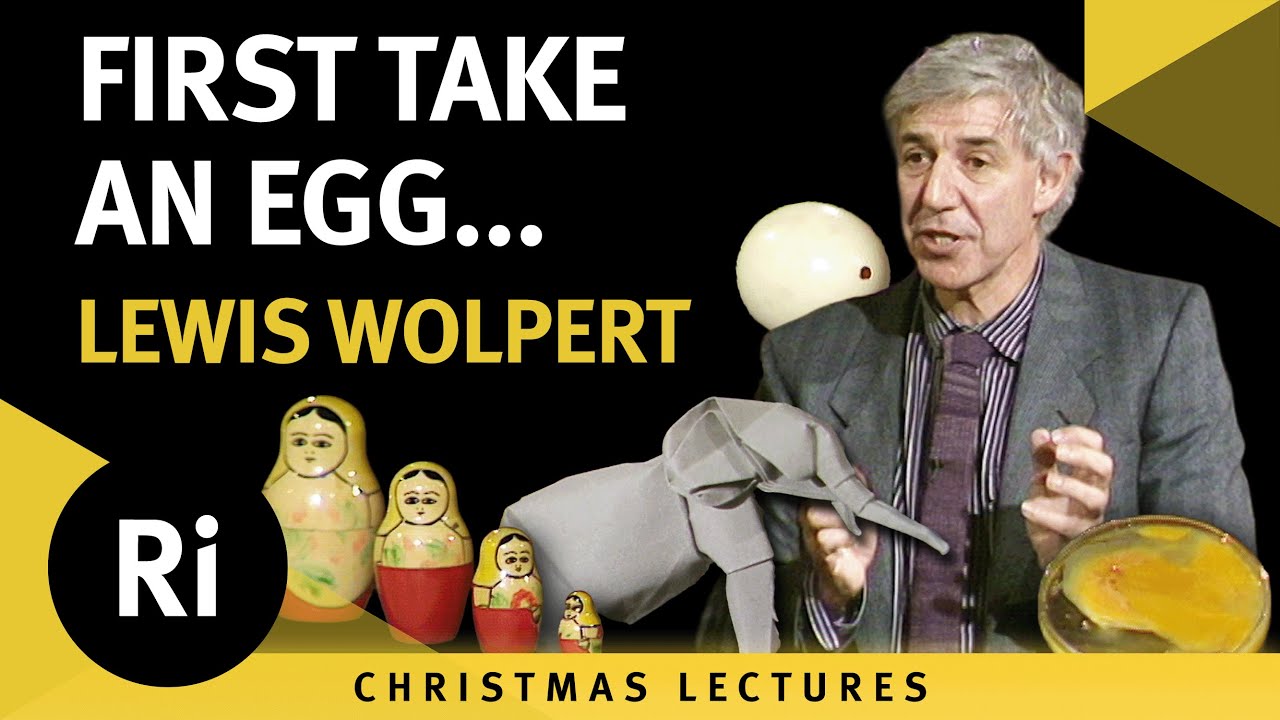
First take an egg... Lewis Wolpert's 1986 Christmas Lectures 1/6
In his first lecture, Professor Lewis Wolpert introduces us to the field of developmental biology, and explores how cells in eggs fold and form embryos.
Watch all the lectures in this series here: https://www.youtube.com/playlist?list=PLbnrZHfNEDZzW3jrFdhIQYcPNlQX-b83V
Watch our newest Christmas lectures here: https://www.youtube.com/playlist?list=PLbnrZHfNEDZyQJZLPMjwEoOLdkFBLU2m1
This lecture was filmed at the Ri on Saturday 20th December 1986.
--
These lectures were originally a YouTube member preview for our Science Supporters. Get access to all of them now by signing up as a YouTube channel member, and help us bring science to more people: https://www.youtube.com/channel/UCYeF244yNGuFefuFKqxIAXw/join
--
We need to know how the cells are assembled to make structures. ls it possible that everything is specified in the egg and that there is a 'homunculus', the animal present as a tiny form which just grows during development? How do sheets of cells get moulded into organs like our brain? Why do we pass through a stage in development when we look a bit like embryonic fish with gill slits?
The way an animal develops can be seen by looking at the sea urchin embryo. The egg divides to give a hollow sphere of about 1,000 cells. Then gastrulation begins - the rearrangement of the early embryo so that the main parts are moved to the right place, like the formation of the gut, which is formed by cells being pulled inwards to form a tube. The cells have micro-muscles which bring about the change in shape. Changes in the adhesion between the cells is also important. Our brains develop from a sheet of cells that folds up into a tube and uses similar mechanisms.
Some cells can migrate long distances to specific sites. How do they find their way? Some make use of chemotaxis - following a chemical gradient, and others explore the environment with long processes and move where they make the most stable contact.
Assembling involves a programme of cell activities like cellular contraction and change in adhesion. The analogy is paper-folding - Origami. A simple programme of instructions can generate very complex forms. This is the programme that Frankenstein needs. In evolution this programme is modified so that a bone from a reptile's lower jaw becomes part of our middle ear.
--
In the 1986 CHRISTMAS LECTURES, Professor Lewis Wolpert (1929-2021) explores developmental biology in a series titled 'Frankenstein's Quest'. Quoting the fictional Dr Frankenstein: "After days and nights of incredible labour and fatigue, I succeeded in discovering the cause of generation and life..." These lectures will look at how life really is generated.
All life comes from cells and all the animals we see about us come from just one cell, the fertilized egg. How does the egg give rise to bats and boys, gnats and girls, eyes and arms? The egg divides and gives rise to many cells which move, multiply, change, and communicate, and from these activities animals emerge through embryonic development. Like an imaginary Frankenstein, we will explore what we need to know in order to control development in order to create not a monster, but an angel.
--
Join this channel to get access to perks:
https://www.youtube.com/channel/UCYeF244yNGuFefuFKqxIAXw/join
Subscribe for regular science videos: http://bit.ly/RiSubscRibe
The Ri is on Twitter: http://twitter.com/ri_science
and Facebook: http://www.facebook.com/royalinstitution
and TikTok: https://www.tiktok.com/@ri_science
Listen to the Ri podcast: https://podcasters.spotify.com/pod/show/ri-science-podcast
Donate to the RI and help us bring you more lectures: https://www.rigb.org/support-us/donate-ri
Our editorial policy: https://www.rigb.org/editing-ri-talks-and-moderating-comments
Subscribe for the latest science videos: http://bit.ly/RiNewsletter
Product links on this page may be affiliate links which means it won't cost you any extra but we may earn a small commission if you decide to purchase through the link.
Watch all the lectures in this series here: https://www.youtube.com/playlist?list=PLbnrZHfNEDZzW3jrFdhIQYcPNlQX-b83V
Watch our newest Christmas lectures here: https://www.youtube.com/playlist?list=PLbnrZHfNEDZyQJZLPMjwEoOLdkFBLU2m1
This lecture was filmed at the Ri on Saturday 20th December 1986.
--
These lectures were originally a YouTube member preview for our Science Supporters. Get access to all of them now by signing up as a YouTube channel member, and help us bring science to more people: https://www.youtube.com/channel/UCYeF244yNGuFefuFKqxIAXw/join
--
We need to know how the cells are assembled to make structures. ls it possible that everything is specified in the egg and that there is a 'homunculus', the animal present as a tiny form which just grows during development? How do sheets of cells get moulded into organs like our brain? Why do we pass through a stage in development when we look a bit like embryonic fish with gill slits?
The way an animal develops can be seen by looking at the sea urchin embryo. The egg divides to give a hollow sphere of about 1,000 cells. Then gastrulation begins - the rearrangement of the early embryo so that the main parts are moved to the right place, like the formation of the gut, which is formed by cells being pulled inwards to form a tube. The cells have micro-muscles which bring about the change in shape. Changes in the adhesion between the cells is also important. Our brains develop from a sheet of cells that folds up into a tube and uses similar mechanisms.
Some cells can migrate long distances to specific sites. How do they find their way? Some make use of chemotaxis - following a chemical gradient, and others explore the environment with long processes and move where they make the most stable contact.
Assembling involves a programme of cell activities like cellular contraction and change in adhesion. The analogy is paper-folding - Origami. A simple programme of instructions can generate very complex forms. This is the programme that Frankenstein needs. In evolution this programme is modified so that a bone from a reptile's lower jaw becomes part of our middle ear.
--
In the 1986 CHRISTMAS LECTURES, Professor Lewis Wolpert (1929-2021) explores developmental biology in a series titled 'Frankenstein's Quest'. Quoting the fictional Dr Frankenstein: "After days and nights of incredible labour and fatigue, I succeeded in discovering the cause of generation and life..." These lectures will look at how life really is generated.
All life comes from cells and all the animals we see about us come from just one cell, the fertilized egg. How does the egg give rise to bats and boys, gnats and girls, eyes and arms? The egg divides and gives rise to many cells which move, multiply, change, and communicate, and from these activities animals emerge through embryonic development. Like an imaginary Frankenstein, we will explore what we need to know in order to control development in order to create not a monster, but an angel.
--
Join this channel to get access to perks:
https://www.youtube.com/channel/UCYeF244yNGuFefuFKqxIAXw/join
Subscribe for regular science videos: http://bit.ly/RiSubscRibe
The Ri is on Twitter: http://twitter.com/ri_science
and Facebook: http://www.facebook.com/royalinstitution
and TikTok: https://www.tiktok.com/@ri_science
Listen to the Ri podcast: https://podcasters.spotify.com/pod/show/ri-science-podcast
Donate to the RI and help us bring you more lectures: https://www.rigb.org/support-us/donate-ri
Our editorial policy: https://www.rigb.org/editing-ri-talks-and-moderating-comments
Subscribe for the latest science videos: http://bit.ly/RiNewsletter
Product links on this page may be affiliate links which means it won't cost you any extra but we may earn a small commission if you decide to purchase through the link.

The Royal Institution
Videos to make you think more deeply about science. Explosive short films, full length talks from the world’s leading scientists and writers, and videos to challenge the way you look at the world.
The Royal Institution is a 200 year old independent chari...
Science, strings and symphonies – Charles Taylor’s 1989 Christmas Lectures 3/5
The Royal Institution
Did Kathleen Lonsdale deserve a Nobel Prize? Her groundbreaking work explained
The Royal Institution