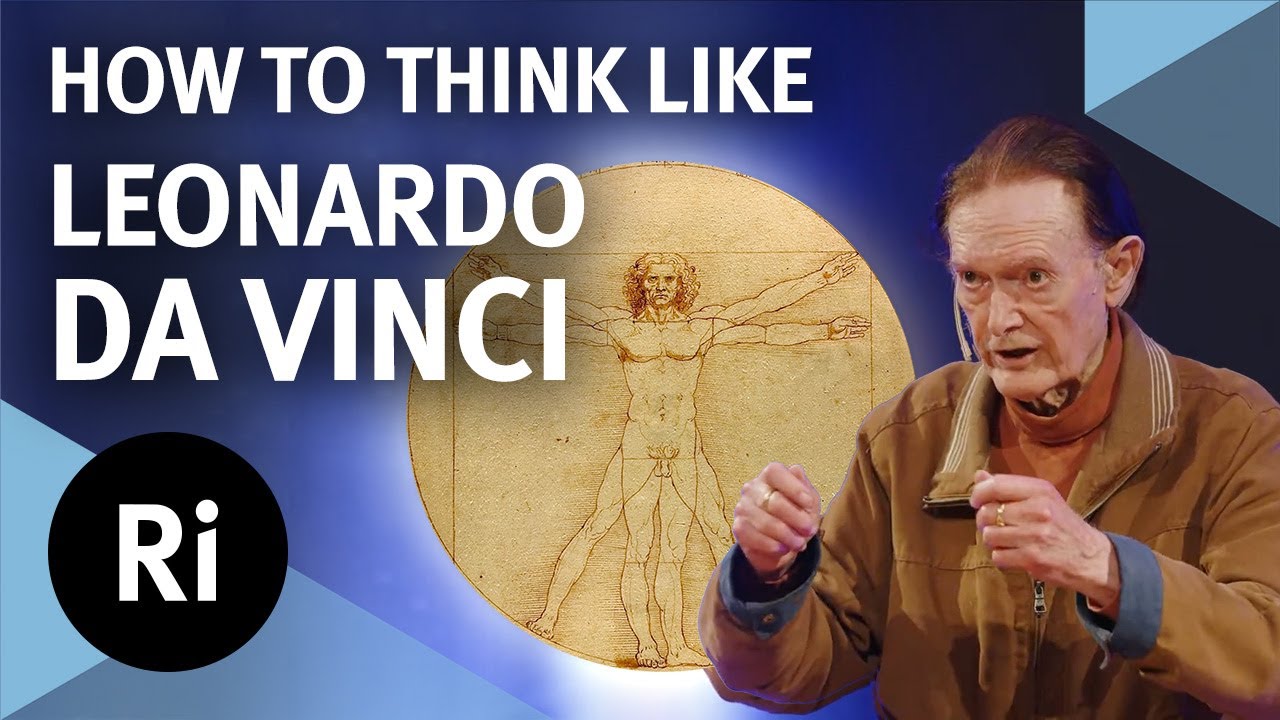
The scientific mind of Leonard Da Vinci - with Martin Kemp
The world's foremost expert on Da Vinci, Martin Kemp, explores what made the great thinker unique.
Join this channel to get access to perks:
https://www.youtube.com/channel/UCYeF244yNGuFefuFKqxIAXw/join
Watch the Q&A here (exclusively for our Science Supporters): https://youtu.be/_T_l4194frY
This lecture was recorded at the Ri on 27 September 2025.
---
Da Vinci expert Martin Kemp explores why Leonardo da Vinci's revolutionary thinking remains startlingly relevant today. Discover how Leonardo saw humanity as integral to nature's design, viewing the human body as a "lesser world" mirroring the cosmos. Through his observations spanning anatomy, geology, optics, and engineering, we'll explore how he pioneered biomimicry, developed an "optics of uncertainty" that prefigures modern physics, and created the iconic Vitruvian Man. Unlike today's compartmentalised knowledge, Leonardo approached learning as a unified whole – knowledge as a branching tree where each discovery illuminated the entire forest. His "lateral seeing" and integration of art with science offer profound lessons for our complex 21st-century world, showing how refusing to separate disciplines might unlock our interconnected challenges.
This talk was recorded at the Ri on 27 September 2025, as part of the finale of the Polymath Festival, curated by the DaVinci Network.
---
Martin Kemp is the world’s leading authority on Leonardo da Vinci. He is Emeritus Professor in the History of Art at Trinity College, Oxford University and is Honorary Chair of the DaVinci Network. He was trained in Natural Sciences and Art History at Cambridge University and the Courtauld Institute, London. His books include, The Science of Art. Optical Themes in Western Art from Brunelleschi to Seurat (Yale), and The Human Animal in Western Art and Science (Chicago). He has published and broadcast extensively on Leonardo da Vinci, including the prize-winning Leonardo da Vinci. The marvellous works of nature and man, and Leonardo (both Oxford). His Christ to Coke. How image becomes icon (Oxford) looks at 11 representatives of types of icons across a wide range of public imagery. He wrote regularly for Nature, his essays for which have been published as Visualizations and developed in Seen and Unseen (both Oxford) in which his concept of “structural intuitions” is explored. His most recent books is Art in History (Profile Books and Structural Intuitions. Seeing Shapes in Art and Science (Virginia).
---
The Ri is on Twitter: http://twitter.com/ri_science
and Facebook: http://www.facebook.com/royalinstitution
and TikTok: https://www.tiktok.com/@ri_science
Listen to the Ri podcast: https://podcasters.spotify.com/pod/show/ri-science-podcast
Donate to the RI and help us bring you more lectures: https://www.rigb.org/support-us/donate-ri
Our editorial policy: https://www.rigb.org/editing-ri-talks-and-moderating-comments
Subscribe for the latest science videos: http://bit.ly/RiNewsletter
Product links on this page may be affiliate links which means it won't cost you any extra but we may earn a small commission if you decide to purchase through the link.
Join this channel to get access to perks:
https://www.youtube.com/channel/UCYeF244yNGuFefuFKqxIAXw/join
Watch the Q&A here (exclusively for our Science Supporters): https://youtu.be/_T_l4194frY
This lecture was recorded at the Ri on 27 September 2025.
---
Da Vinci expert Martin Kemp explores why Leonardo da Vinci's revolutionary thinking remains startlingly relevant today. Discover how Leonardo saw humanity as integral to nature's design, viewing the human body as a "lesser world" mirroring the cosmos. Through his observations spanning anatomy, geology, optics, and engineering, we'll explore how he pioneered biomimicry, developed an "optics of uncertainty" that prefigures modern physics, and created the iconic Vitruvian Man. Unlike today's compartmentalised knowledge, Leonardo approached learning as a unified whole – knowledge as a branching tree where each discovery illuminated the entire forest. His "lateral seeing" and integration of art with science offer profound lessons for our complex 21st-century world, showing how refusing to separate disciplines might unlock our interconnected challenges.
This talk was recorded at the Ri on 27 September 2025, as part of the finale of the Polymath Festival, curated by the DaVinci Network.
---
Martin Kemp is the world’s leading authority on Leonardo da Vinci. He is Emeritus Professor in the History of Art at Trinity College, Oxford University and is Honorary Chair of the DaVinci Network. He was trained in Natural Sciences and Art History at Cambridge University and the Courtauld Institute, London. His books include, The Science of Art. Optical Themes in Western Art from Brunelleschi to Seurat (Yale), and The Human Animal in Western Art and Science (Chicago). He has published and broadcast extensively on Leonardo da Vinci, including the prize-winning Leonardo da Vinci. The marvellous works of nature and man, and Leonardo (both Oxford). His Christ to Coke. How image becomes icon (Oxford) looks at 11 representatives of types of icons across a wide range of public imagery. He wrote regularly for Nature, his essays for which have been published as Visualizations and developed in Seen and Unseen (both Oxford) in which his concept of “structural intuitions” is explored. His most recent books is Art in History (Profile Books and Structural Intuitions. Seeing Shapes in Art and Science (Virginia).
---
The Ri is on Twitter: http://twitter.com/ri_science
and Facebook: http://www.facebook.com/royalinstitution
and TikTok: https://www.tiktok.com/@ri_science
Listen to the Ri podcast: https://podcasters.spotify.com/pod/show/ri-science-podcast
Donate to the RI and help us bring you more lectures: https://www.rigb.org/support-us/donate-ri
Our editorial policy: https://www.rigb.org/editing-ri-talks-and-moderating-comments
Subscribe for the latest science videos: http://bit.ly/RiNewsletter
Product links on this page may be affiliate links which means it won't cost you any extra but we may earn a small commission if you decide to purchase through the link.

The Royal Institution
Videos to make you think more deeply about science. Explosive short films, full length talks from the world’s leading scientists and writers, and videos to challenge the way you look at the world.
The Royal Institution is a 200 year old independent chari...
Science, strings and symphonies – Charles Taylor’s 1989 Christmas Lectures 3/5
The Royal Institution
Did Kathleen Lonsdale deserve a Nobel Prize? Her groundbreaking work explained
The Royal Institution