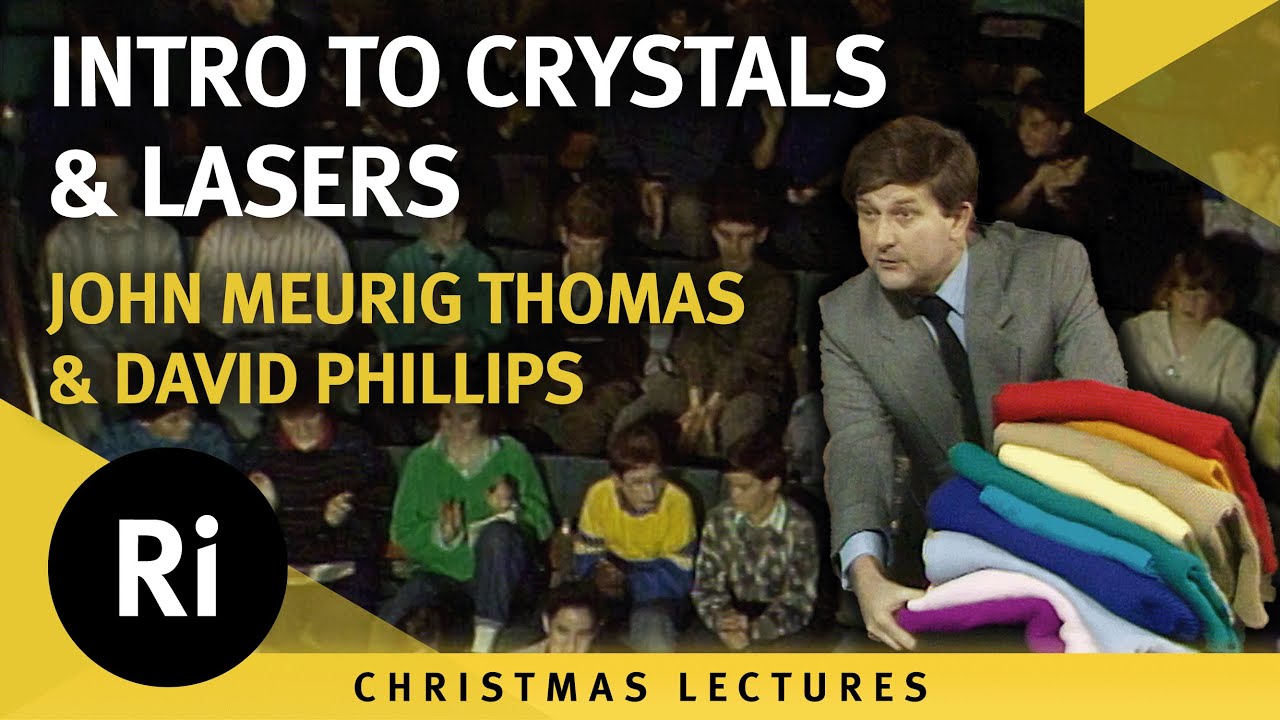
Introduction to Crystals & Lasers - John M. Thomas & David Phillips's 1987 Christmas Lectures 1/6
In their first lecture, John Meurig Thomas and David Phillips examine the symmetry and other striking physical characteristics of minerals and gemstones.
Watch all the lectures in this series here: https://www.youtube.com/playlist?list=PLbnrZHfNEDZw7s3y3S1IsaEmka5MWlaq9
Watch our newest Christmas lectures here: https://www.youtube.com/playlist?list=PLbnrZHfNEDZyQJZLPMjwEoOLdkFBLU2m1
This lecture was filmed at the Ri on Saturday 19th December 1987.
--
A wealth of information relating to the nature of crystals can be gleaned from an examination of the symmetry and other striking physical characteristics of minerals and gemstones. Especially revealing are their optical, thermal and electrical properties. Coloured solids, be they fashioned by Nature over geological time or in the laboratory on the scale of human activity, as well as the luminescence induced within them by illumination with ultra-violet light or electrons, tell us a great deal about the interior of crystals and about the nature of light itself. In turn, by probing a few other properties of both familiar and unfamiliar minerals and man-made crystals, we can understand the processes entailed in creating colour, in the emission of light and, in particular, in the contrast between incandescence and laser action.
--
Crystals first appeared on earth many millions of years before the emergence of life. The first laser, however, based on a man-made crystal of ruby, was fashioned less than thirty years ago. Nowadays, crystals and lasers play crucial roles in the design of new materials, in the expanding world of communications, in medicine and environmental science and in the quest for better, cleaner forms of energy. They also function as the picot for a wide range of fundamental scientific studies.
In this series of six CHRISTMAS LECTURES, Professors John Meurig Thomas (1932-2020) and David Phillips (b.1939) explore the science and applications of crystals and lasers, reviving some of the key experiments from the history and evolution of physical sciences and exploring what the future might bring.
--
Join this channel to get access to perks:
https://www.youtube.com/channel/UCYeF244yNGuFefuFKqxIAXw/join
Subscribe for regular science videos: http://bit.ly/RiSubscRibe
The Ri is on Twitter: http://twitter.com/ri_science
and Facebook: http://www.facebook.com/royalinstitution
and TikTok: https://www.tiktok.com/@ri_science
Listen to the Ri podcast: https://podcasters.spotify.com/pod/show/ri-science-podcast
Donate to the RI and help us bring you more lectures: https://www.rigb.org/support-us/donate-ri
Our editorial policy: https://www.rigb.org/editing-ri-talks-and-moderating-comments
Subscribe for the latest science videos: http://bit.ly/RiNewsletter
Product links on this page may be affiliate links which means it won't cost you any extra but we may earn a small commission if you decide to purchase through the link.
Watch all the lectures in this series here: https://www.youtube.com/playlist?list=PLbnrZHfNEDZw7s3y3S1IsaEmka5MWlaq9
Watch our newest Christmas lectures here: https://www.youtube.com/playlist?list=PLbnrZHfNEDZyQJZLPMjwEoOLdkFBLU2m1
This lecture was filmed at the Ri on Saturday 19th December 1987.
--
A wealth of information relating to the nature of crystals can be gleaned from an examination of the symmetry and other striking physical characteristics of minerals and gemstones. Especially revealing are their optical, thermal and electrical properties. Coloured solids, be they fashioned by Nature over geological time or in the laboratory on the scale of human activity, as well as the luminescence induced within them by illumination with ultra-violet light or electrons, tell us a great deal about the interior of crystals and about the nature of light itself. In turn, by probing a few other properties of both familiar and unfamiliar minerals and man-made crystals, we can understand the processes entailed in creating colour, in the emission of light and, in particular, in the contrast between incandescence and laser action.
--
Crystals first appeared on earth many millions of years before the emergence of life. The first laser, however, based on a man-made crystal of ruby, was fashioned less than thirty years ago. Nowadays, crystals and lasers play crucial roles in the design of new materials, in the expanding world of communications, in medicine and environmental science and in the quest for better, cleaner forms of energy. They also function as the picot for a wide range of fundamental scientific studies.
In this series of six CHRISTMAS LECTURES, Professors John Meurig Thomas (1932-2020) and David Phillips (b.1939) explore the science and applications of crystals and lasers, reviving some of the key experiments from the history and evolution of physical sciences and exploring what the future might bring.
--
Join this channel to get access to perks:
https://www.youtube.com/channel/UCYeF244yNGuFefuFKqxIAXw/join
Subscribe for regular science videos: http://bit.ly/RiSubscRibe
The Ri is on Twitter: http://twitter.com/ri_science
and Facebook: http://www.facebook.com/royalinstitution
and TikTok: https://www.tiktok.com/@ri_science
Listen to the Ri podcast: https://podcasters.spotify.com/pod/show/ri-science-podcast
Donate to the RI and help us bring you more lectures: https://www.rigb.org/support-us/donate-ri
Our editorial policy: https://www.rigb.org/editing-ri-talks-and-moderating-comments
Subscribe for the latest science videos: http://bit.ly/RiNewsletter
Product links on this page may be affiliate links which means it won't cost you any extra but we may earn a small commission if you decide to purchase through the link.

The Royal Institution
Videos to make you think more deeply about science. Explosive short films, full length talks from the world’s leading scientists and writers, and videos to challenge the way you look at the world.
The Royal Institution is a 200 year old independent chari...
Science, strings and symphonies – Charles Taylor’s 1989 Christmas Lectures 3/5
The Royal Institution
Did Kathleen Lonsdale deserve a Nobel Prize? Her groundbreaking work explained
The Royal Institution