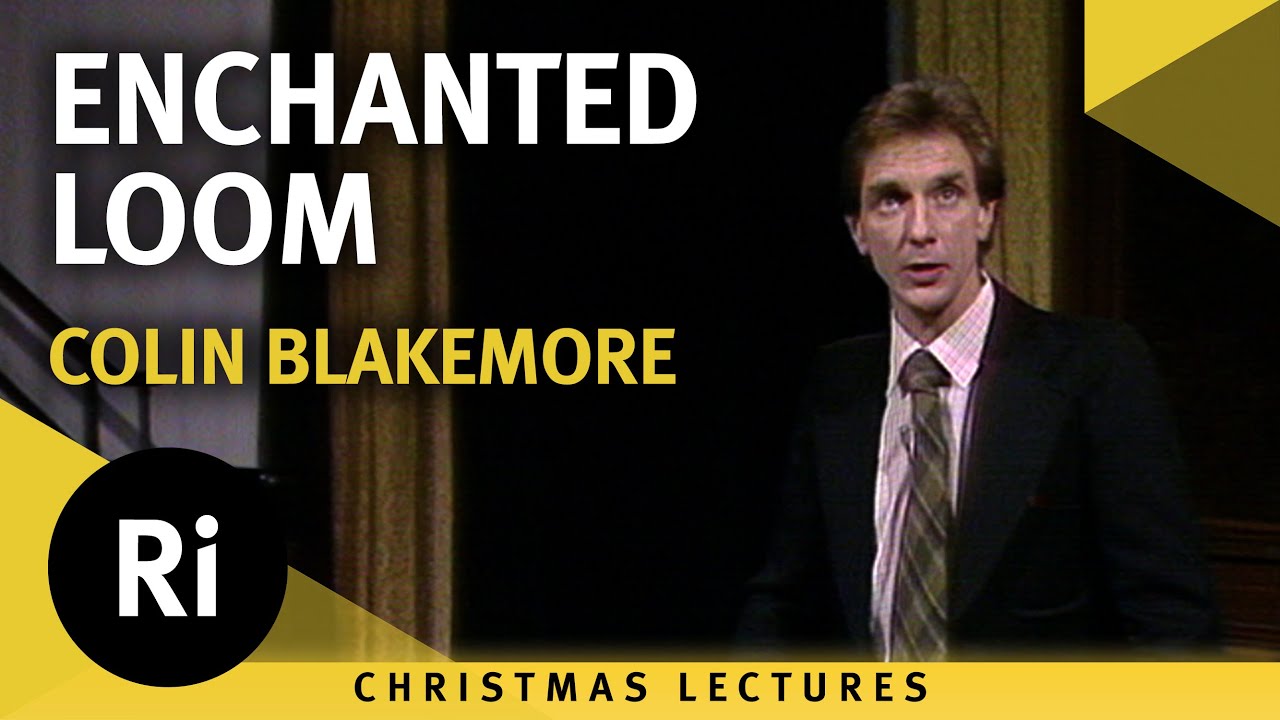
Enchanted loom - Colin Blakemore's 1982 Christmas Lectures 6/6
Colin Blakemore's final lecture builds on his previous five lectures to explore how all the senses work together.
Watch all the lectures in this series here: https://youtube.com/playlist?list=PLbnrZHfNEDZwsBFLaHIdC8Xs-na8lUk3i&si=x8JAyJZ3KzJjqBob
Watch our newest Christmas lectures here: https://www.youtube.com/playlist?list=PLbnrZHfNEDZyQJZLPMjwEoOLdkFBLU2m1
This lecture was recorded at the Ri on 31 December 1982.
Find out more about the CHRISTMAS LECTURES here: https://www.rigb.org/christmas-lectures
--
Lecture 6: Enchanted loom
The brain-the Enchanted Loom as Sir Charles Sherrington, one of the founders of modern brain research, called it is quite simply, the most intricate, complex, almost miraculous product of evolution. The tapestry woven in the loom of the human brain has one hundred thousand million threads - the fibres of all its nerve cells. Its complexity and performance, in almost all respects, far exceed the capabilities of any computer . Computers have very good memories and can perform prodigious feats of mathematical calculation, but they are pathetically slow and simple-minded when it comes to interpreting visual images that we can recognise at a glance. Even the simplest of animals have some sort of sensory detectors but not all animals have brains. The brain seems to have evolved in parallel with the increase in sensory capacity and the use of sensory information to guide and control the animal's behaviour. Indeed, two-thirds or more of the entire human cerebral cortex is probably devoted to the analysis and interpretation of signals from the sense organs. What may have started as a simple set of connections between sense organs and muscles or glands has become the instrument of perception, of reason, of thought and of free will. The human brain is not a passive servant of the sense organs: it is a thoughtful and versatile machine, which not only sorts and classifies sensory information, searching for clues to important events in the outside world, but also goes beyond the messages from the sense organs, intelligently interpreting on the basis of expectation, past experience and information from other sources. We don't just see the retinal image in our eye: we perceive a 'model' of the outside world created inside our heads, and that model is, in many ways, a more reliable copy of the physical world than the retinal image itself. In our perceptual world, objects can be identified and classified regardless of their distance from the eyes or their orientation in space. The photochemical reaction in the receptor cells in our eyes is probably very similar to that occurring in the light-detecting structures in the first photosensitive animals. They were merely capable of detecting whether it was light or dark. We can recognise things; we know where they are and how far away; we see their colour, shape and movement. We see the significance of the world about us. All this we owe to the brain - the searcher for meaning.
--
About the 1982 CHRISTMAS LECTURES: Common Sense
Our sense organs are windows on the world. But just like windows, as well as giving us a view of the physical world, the senses also restrict our outlook on the things around us. Philosophers have worried for centuries about the reliability of the human senses and about the relationship between the real world and the world as we see, hear and feel it. Is the world only a creation of our minds? I am no philosopher, so I am happy to accept that there is a real world out there and that our sense organs simply describe it to our brains. But this means that the world we know through our perceptions is created by processes in our brains and the validity of this imagined world depends crucially on the way that our sense organs and our brains work together to perform the magic of perception. My aim in these lectures is to describe the way that the sense organs act as biological instruments of detection, measurement and analysis.
--
About Colin Blakemore:
Sir Colin Blakemore (1 June 1944 – 27 June 2022) was a British neurobiologist, specialising in vision and the development of the brain. His own research work was mainly concerned with the mechanisms in the brain for the interpretation of signals from the eyes, and especially in the early development of vision during the first few days and weeks of an animal's life. He was well known for his work in communicating science to the public and published many popular books.
Watch all the lectures in this series here: https://youtube.com/playlist?list=PLbnrZHfNEDZwsBFLaHIdC8Xs-na8lUk3i&si=x8JAyJZ3KzJjqBob
Watch our newest Christmas lectures here: https://www.youtube.com/playlist?list=PLbnrZHfNEDZyQJZLPMjwEoOLdkFBLU2m1
This lecture was recorded at the Ri on 31 December 1982.
Find out more about the CHRISTMAS LECTURES here: https://www.rigb.org/christmas-lectures
--
Lecture 6: Enchanted loom
The brain-the Enchanted Loom as Sir Charles Sherrington, one of the founders of modern brain research, called it is quite simply, the most intricate, complex, almost miraculous product of evolution. The tapestry woven in the loom of the human brain has one hundred thousand million threads - the fibres of all its nerve cells. Its complexity and performance, in almost all respects, far exceed the capabilities of any computer . Computers have very good memories and can perform prodigious feats of mathematical calculation, but they are pathetically slow and simple-minded when it comes to interpreting visual images that we can recognise at a glance. Even the simplest of animals have some sort of sensory detectors but not all animals have brains. The brain seems to have evolved in parallel with the increase in sensory capacity and the use of sensory information to guide and control the animal's behaviour. Indeed, two-thirds or more of the entire human cerebral cortex is probably devoted to the analysis and interpretation of signals from the sense organs. What may have started as a simple set of connections between sense organs and muscles or glands has become the instrument of perception, of reason, of thought and of free will. The human brain is not a passive servant of the sense organs: it is a thoughtful and versatile machine, which not only sorts and classifies sensory information, searching for clues to important events in the outside world, but also goes beyond the messages from the sense organs, intelligently interpreting on the basis of expectation, past experience and information from other sources. We don't just see the retinal image in our eye: we perceive a 'model' of the outside world created inside our heads, and that model is, in many ways, a more reliable copy of the physical world than the retinal image itself. In our perceptual world, objects can be identified and classified regardless of their distance from the eyes or their orientation in space. The photochemical reaction in the receptor cells in our eyes is probably very similar to that occurring in the light-detecting structures in the first photosensitive animals. They were merely capable of detecting whether it was light or dark. We can recognise things; we know where they are and how far away; we see their colour, shape and movement. We see the significance of the world about us. All this we owe to the brain - the searcher for meaning.
--
About the 1982 CHRISTMAS LECTURES: Common Sense
Our sense organs are windows on the world. But just like windows, as well as giving us a view of the physical world, the senses also restrict our outlook on the things around us. Philosophers have worried for centuries about the reliability of the human senses and about the relationship between the real world and the world as we see, hear and feel it. Is the world only a creation of our minds? I am no philosopher, so I am happy to accept that there is a real world out there and that our sense organs simply describe it to our brains. But this means that the world we know through our perceptions is created by processes in our brains and the validity of this imagined world depends crucially on the way that our sense organs and our brains work together to perform the magic of perception. My aim in these lectures is to describe the way that the sense organs act as biological instruments of detection, measurement and analysis.
--
About Colin Blakemore:
Sir Colin Blakemore (1 June 1944 – 27 June 2022) was a British neurobiologist, specialising in vision and the development of the brain. His own research work was mainly concerned with the mechanisms in the brain for the interpretation of signals from the eyes, and especially in the early development of vision during the first few days and weeks of an animal's life. He was well known for his work in communicating science to the public and published many popular books.

The Royal Institution
Videos to make you think more deeply about science. Explosive short films, full length talks from the world’s leading scientists and writers, and videos to challenge the way you look at the world.
The Royal Institution is a 200 year old independent chari...
Science, strings and symphonies – Charles Taylor’s 1989 Christmas Lectures 3/5
The Royal Institution
Did Kathleen Lonsdale deserve a Nobel Prize? Her groundbreaking work explained
The Royal Institution