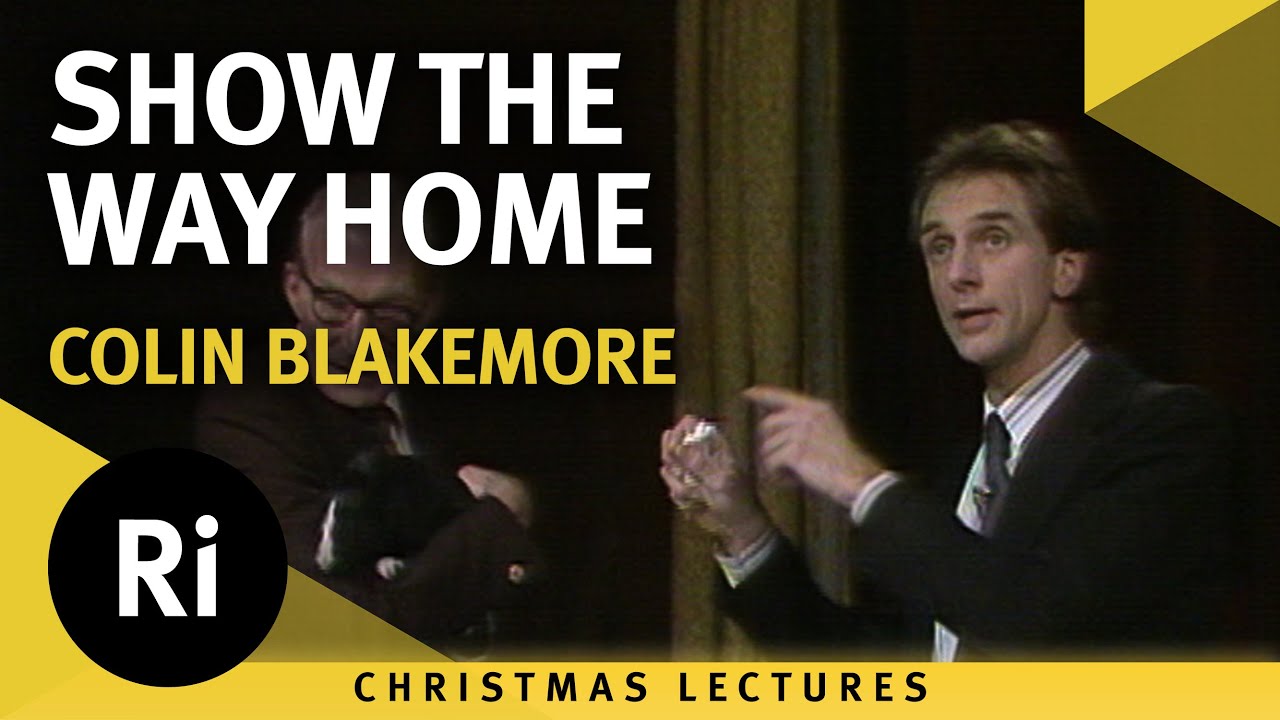
Show me the way to go home - Colin Blakemore's 1982 Christmas Lectures 4/6
Colin Blakemore continues his 1982 CHRISTMAS LECTURES with an exploration of biological navigation systems.
Watch all the lectures in this series here: https://youtube.com/playlist?list=PLbnrZHfNEDZwsBFLaHIdC8Xs-na8lUk3i&si=x8JAyJZ3KzJjqBob
Watch our newest Christmas lectures here: https://www.youtube.com/playlist?list=PLbnrZHfNEDZyQJZLPMjwEoOLdkFBLU2m1
Find out more about the CHRISTMAS LECTURES here: https://www.rigb.org/christmas-lectures
This lecture was recorded at the Ri on 23 December 1982.
--
Lecture 4: Where am I?
Without a map or an intimate knowledge of the area, human beings are not very good at finding their way around. Our senses alone don't allow us to navigate and to explore with great efficiency. Other species, however , perform extraordinary feats of navigation, and they rely on a battery of remarkable sensory skills. The salmon searching for its home stream, the pigeon flying to its roost, migrating birds and fish, and even foraging insects have special sensory systems to enable them to guide themselves. The homing pigeon is a particularly good example: it can steer itself by the sun or the stars (but it needs an internal clock in its brain to do so), and it also has a built-in magnetic sense to act as a personal compass. And finally it uses the sight of familiar things on the ground to guide it precisely to its destination. All animals, not just those that are especially good at migration, need to know where they are in relation to gravity and to the things around them in order to regulate their posture and their movements. Vision is often important but there are also special sensory systems in the inner ear of mammals and in the lateral line organs of fishes that detect the direction of gravity, angular rotation in any plane and movement of water around the body. Most animals, including human beings, use sensory information from a variety of sources to keep the head and eyes relatively stable in space when the body is being moved about or is actively moving through space. Finally there is the fascinating question of how we know where all the bits of our body are and how they link together. Proprioception - the detection of the positions of joints, the lengths of muscles and the relationships of all the parts of the body - is a vital sense, but one that we are not normally vividly aware of.
Join this channel to get access to perks:
https://www.youtube.com/channel/UCYeF244yNGuFefuFKqxIAXw/join
Subscribe for regular science videos: http://bit.ly/RiSubscRibe
Watch all the lectures in this series here: https://youtube.com/playlist?list=PLbnrZHfNEDZwsBFLaHIdC8Xs-na8lUk3i&si=x8JAyJZ3KzJjqBob
Watch our newest Christmas lectures here: https://www.youtube.com/playlist?list=PLbnrZHfNEDZyQJZLPMjwEoOLdkFBLU2m1
Find out more about the CHRISTMAS LECTURES here: https://www.rigb.org/christmas-lectures
This lecture was recorded at the Ri on 23 December 1982.
--
Lecture 4: Where am I?
Without a map or an intimate knowledge of the area, human beings are not very good at finding their way around. Our senses alone don't allow us to navigate and to explore with great efficiency. Other species, however , perform extraordinary feats of navigation, and they rely on a battery of remarkable sensory skills. The salmon searching for its home stream, the pigeon flying to its roost, migrating birds and fish, and even foraging insects have special sensory systems to enable them to guide themselves. The homing pigeon is a particularly good example: it can steer itself by the sun or the stars (but it needs an internal clock in its brain to do so), and it also has a built-in magnetic sense to act as a personal compass. And finally it uses the sight of familiar things on the ground to guide it precisely to its destination. All animals, not just those that are especially good at migration, need to know where they are in relation to gravity and to the things around them in order to regulate their posture and their movements. Vision is often important but there are also special sensory systems in the inner ear of mammals and in the lateral line organs of fishes that detect the direction of gravity, angular rotation in any plane and movement of water around the body. Most animals, including human beings, use sensory information from a variety of sources to keep the head and eyes relatively stable in space when the body is being moved about or is actively moving through space. Finally there is the fascinating question of how we know where all the bits of our body are and how they link together. Proprioception - the detection of the positions of joints, the lengths of muscles and the relationships of all the parts of the body - is a vital sense, but one that we are not normally vividly aware of.
Join this channel to get access to perks:
https://www.youtube.com/channel/UCYeF244yNGuFefuFKqxIAXw/join
Subscribe for regular science videos: http://bit.ly/RiSubscRibe

The Royal Institution
Videos to make you think more deeply about science. Explosive short films, full length talks from the world’s leading scientists and writers, and videos to challenge the way you look at the world.
The Royal Institution is a 200 year old independent chari...
Science, strings and symphonies – Charles Taylor’s 1989 Christmas Lectures 3/5
The Royal Institution
Did Kathleen Lonsdale deserve a Nobel Prize? Her groundbreaking work explained
The Royal Institution