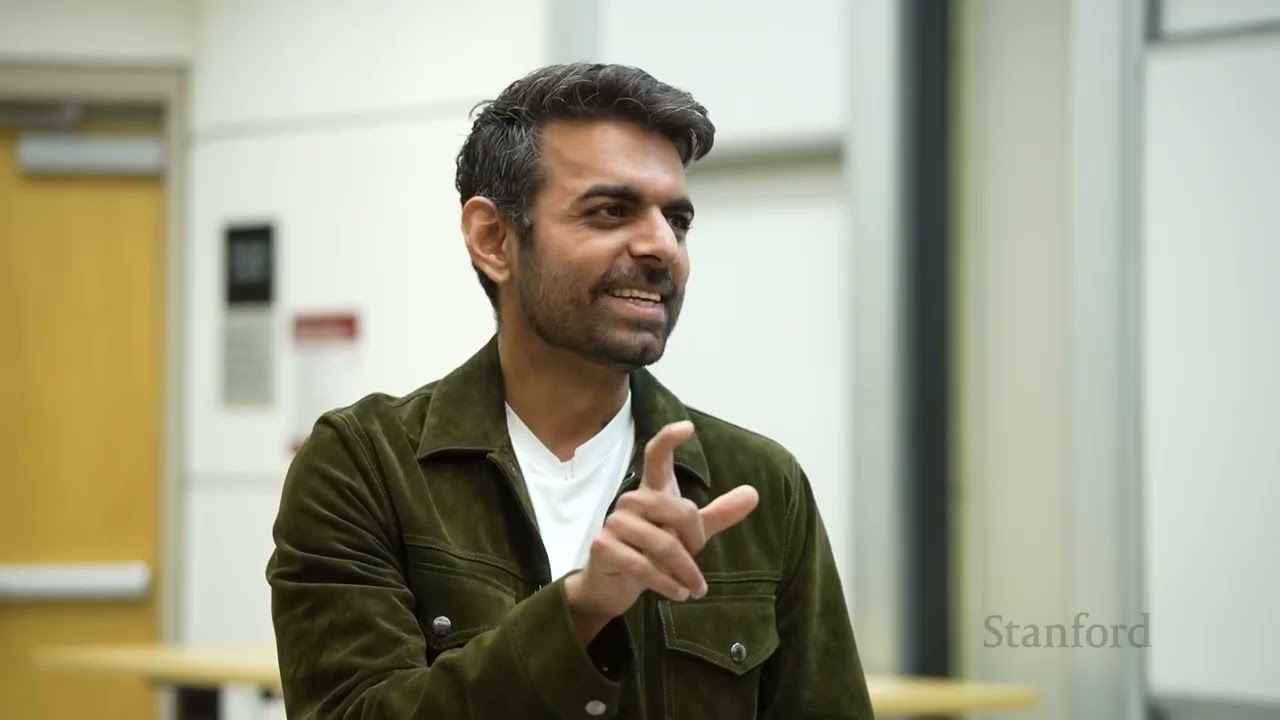
Stanford CS153 Frontier Systems | Teaching AI to Touch Atoms
For more information about Stanford's online Artificial Intelligence programs, visit: https://stanford.io/ai
Follow along with the course schedule and syllabus; visit: https://cs153.stanford.edu/
In this CS 153 Frontier Systems lecture, Periodic Labs cofounders Liam Ferriss and Dorje Chubak — veterans of OpenAI's post-training team and DeepMind's Genome project, respectively — walked students through their eleven-month-old mission to apply AI to the physical world, specifically using autonomous labs to accelerate the discovery of new materials including high-temperature superconductors.
Operating out of a 40,000-square-foot Menlo Park facility where machine learning researchers work alongside physicists and chemists, their AI system (named Onnes, after the scientist who discovered superconductivity in 1908) runs a continuous loop of computational prediction, robotic synthesis, and experimental verification — closing the feedback cycle between digital intelligence and physical reality in a way no purely in-silico approach can. A key early lesson was abandoning their original plan of spending the first year purely computational: building smaller, semi-manual labs first allowed them to direct the research program and understand what to scale, faster.
Dorje emphasized that the results of applying LLMs to actual atoms have exceeded even their own expectations, while Liam stressed that sample efficiency in reinforcement learning — not benchmark climbing — is the core technical frontier when physical experiments can't be arbitrarily scaled up the way digital rollouts can. They closed by pushing back on student anxiety about AGI displacing their careers, arguing that most scientific domains remain largely untouched by LLMs, that the bar to make meaningful AI-physical world progress is still surprisingly low, and that the history of civilization is essentially a materials story — making their work, in their view, among the highest-leverage bets anyone can make right now.
Follow along with the course schedule and syllabus; visit: https://cs153.stanford.edu/
In this CS 153 Frontier Systems lecture, Periodic Labs cofounders Liam Ferriss and Dorje Chubak — veterans of OpenAI's post-training team and DeepMind's Genome project, respectively — walked students through their eleven-month-old mission to apply AI to the physical world, specifically using autonomous labs to accelerate the discovery of new materials including high-temperature superconductors.
Operating out of a 40,000-square-foot Menlo Park facility where machine learning researchers work alongside physicists and chemists, their AI system (named Onnes, after the scientist who discovered superconductivity in 1908) runs a continuous loop of computational prediction, robotic synthesis, and experimental verification — closing the feedback cycle between digital intelligence and physical reality in a way no purely in-silico approach can. A key early lesson was abandoning their original plan of spending the first year purely computational: building smaller, semi-manual labs first allowed them to direct the research program and understand what to scale, faster.
Dorje emphasized that the results of applying LLMs to actual atoms have exceeded even their own expectations, while Liam stressed that sample efficiency in reinforcement learning — not benchmark climbing — is the core technical frontier when physical experiments can't be arbitrarily scaled up the way digital rollouts can. They closed by pushing back on student anxiety about AGI displacing their careers, arguing that most scientific domains remain largely untouched by LLMs, that the bar to make meaningful AI-physical world progress is still surprisingly low, and that the history of civilization is essentially a materials story — making their work, in their view, among the highest-leverage bets anyone can make right now.

Stanford Online
You can gain access to a world of education through Stanford Online, the Stanford School of Engineering’s portal for academic and professional education offered by schools and units throughout Stanford University. https://online.stanford.edu/
Our robust ...