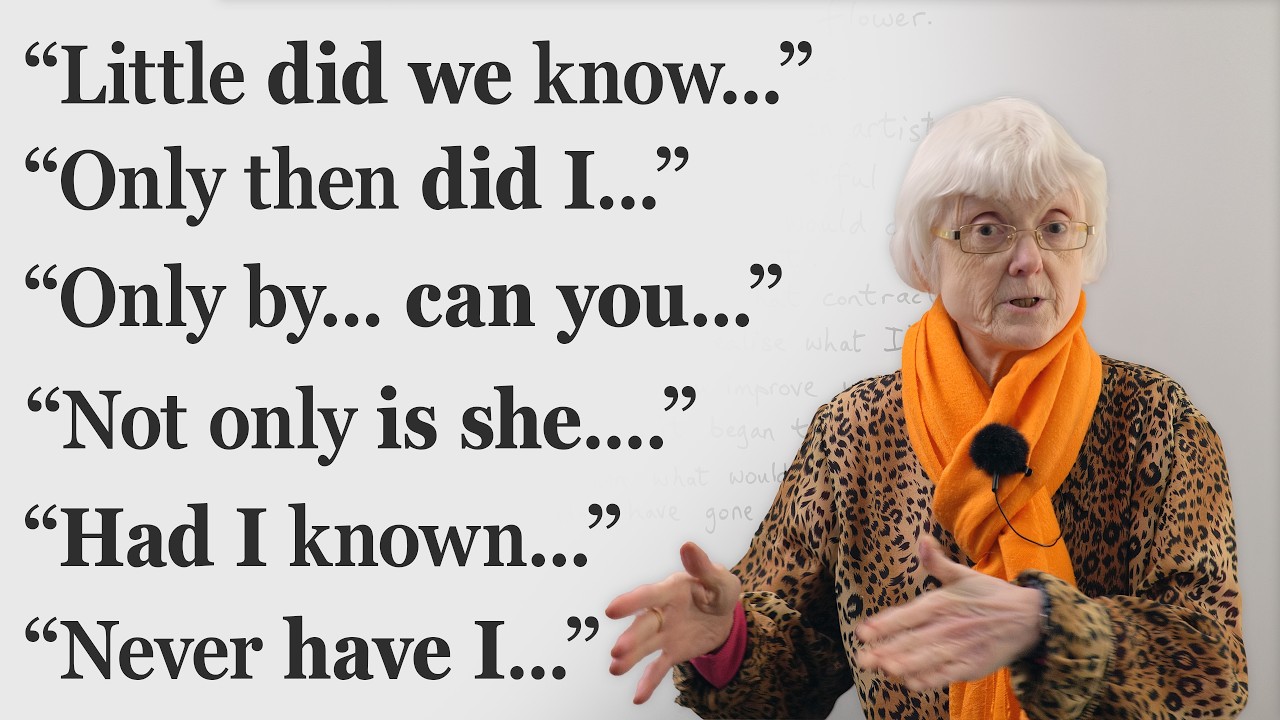
11 English Word Inversions: “Never have I”, “Little did I know”, “Not only is”
Have you ever read a sentence like _“Little did I know...”_ or _“Never have I seen...”_ and wondered why the word order looks so strange? This is called *inversion,* and this advanced English grammar lesson will help you understand it, and use it in your own writing. You will find inversion used most often in dramatic writing or films set in the past. In this class, I will show you eleven common inversion examples including “never have I”, “only then did I”, “not only is”, “little did I know”, “no sooner had I”, and more. After the lesson, try writing your own dramatic sentence in the comments using one of these structures. Test yourself with the quiz: https://www.engvid.com/advanced-english-grammar-word-order-inversions/
Learn more old-fashioned English:
https://youtu.be/vlpq241xQTw
https://youtu.be/AeWrsem6NKI
In this lesson:
0:00 Word Order Inversion in English Writing
1:32 "Never have I..."
2:41 "Only then did..."
3:58 "Not only..."
4:52 "Seldom have I..."
5:58 "Little did I know..."
6:52 "In no way..."
7:24 "On no account..."
7:56 "Only when..."
8:36 "Only by..."
9:22 "No sooner had..."
10:05 "Had I known..."
TRANSCRIPT:
Hello. I'm Gill at engVid, and today's lesson is a rather advanced lesson on word order
changes, also known as word order inversion, which happens after certain words and phrases,
which we have in red here on the left. And this is something that it's a little bit unusual
- it sounds a bit strange, it's a rather almost poetic kind of style, something that
you'd see more in writing than in speaking. If people spoke like this, it would sound
a little bit unusual, a little bit strange, unless they're actors in a play that was written
100 years ago or more, then you would hear that sort of thing. And also, if you're reading
a novel or a story that was written quite a long time ago, you might see these kinds
of word orders written in the story, in a book. So, it's a useful thing to know about,
and if you ever need to use it yourself, it's a useful thing to be able to do if you want
to write in a certain style.
So, okay, so let's have a look at the examples. So, if you start a sentence with "never",
that's when you have to change the word order, and instead of saying... If you started with
"I", "I have never seen", then it's "I have never seen". But if you start the sentence
with "never", maybe for emphasis, it's more dramatic in a way. "Never have I seen", and
it's a sort of strong, dramatic statement. So, "Never have I seen", rather than "Never
I have seen". So, you can start with "I have", "I have never seen", but if you start the
sentence with "never", you have to change the order of "I have" to "have I". "Never
have I seen such a lovely flower." Okay? So, this is the same kind of idea all the way
through where we're reversing some of the words.
So, similarly then, "Only then did I realize". I suppose if you're... If you're not going
to start the sentence with "only then", you'd say, "I realized then who she was", and then
you don't even need the auxiliary verb "did", but because we've started "only then", "Did
I realize". So, "only then", you wouldn't say, "Only then I realized", it doesn't sound
quite right. You have to use "did" with it. "Only then did I realize who she was." If
you meet somebody famous and you don't really recognize them at first, but then when the
person begins to speak, oh, you recognize the voice, and then, "Only then did I realize
who she was." A famous actress, maybe. Okay. Again, it's more dramatic. "Only then did
I realize". Okay. So, then this one, "not only", and then with a "but" somewhere in
the sentence. So, "Not only is she a singer, but she's an artist too." So, if you weren't
beginning the sentence with "not only", you'd say, "She is not only a singer, but also an
artist", but that doesn't sound quite so good. So, it sounds better to begin with "not only".
"Not only is she a singer", I think the order the words come in, the rhythm of it, the shape
of it sounds better this way. "Not only is she a singer, but she's an artist too." So,
the words kind of come at the right moment. It sounds better.
Okay, then this word, it's a bit unusual. "Seldom", but it means not often, not very
often. So, "seldom" means not often. "Seldom have I heard such a beautiful song." So, you
could start with "I have seldom heard", and you would have a different word order. So,
if you start with "seldom", you've got to have "I have" reversed instead of "I have
seldom heard". It's "Seldom have I heard such a beautiful song", but that's a very sort
of old-fashioned-sounding style. You would read it in a book, I think, or hear it in
a play that was written many years ago, but you wouldn't hear people saying it, I don't
think, in... Nowadays, in everyday conversation. […]
Learn more old-fashioned English:
https://youtu.be/vlpq241xQTw
https://youtu.be/AeWrsem6NKI
In this lesson:
0:00 Word Order Inversion in English Writing
1:32 "Never have I..."
2:41 "Only then did..."
3:58 "Not only..."
4:52 "Seldom have I..."
5:58 "Little did I know..."
6:52 "In no way..."
7:24 "On no account..."
7:56 "Only when..."
8:36 "Only by..."
9:22 "No sooner had..."
10:05 "Had I known..."
TRANSCRIPT:
Hello. I'm Gill at engVid, and today's lesson is a rather advanced lesson on word order
changes, also known as word order inversion, which happens after certain words and phrases,
which we have in red here on the left. And this is something that it's a little bit unusual
- it sounds a bit strange, it's a rather almost poetic kind of style, something that
you'd see more in writing than in speaking. If people spoke like this, it would sound
a little bit unusual, a little bit strange, unless they're actors in a play that was written
100 years ago or more, then you would hear that sort of thing. And also, if you're reading
a novel or a story that was written quite a long time ago, you might see these kinds
of word orders written in the story, in a book. So, it's a useful thing to know about,
and if you ever need to use it yourself, it's a useful thing to be able to do if you want
to write in a certain style.
So, okay, so let's have a look at the examples. So, if you start a sentence with "never",
that's when you have to change the word order, and instead of saying... If you started with
"I", "I have never seen", then it's "I have never seen". But if you start the sentence
with "never", maybe for emphasis, it's more dramatic in a way. "Never have I seen", and
it's a sort of strong, dramatic statement. So, "Never have I seen", rather than "Never
I have seen". So, you can start with "I have", "I have never seen", but if you start the
sentence with "never", you have to change the order of "I have" to "have I". "Never
have I seen such a lovely flower." Okay? So, this is the same kind of idea all the way
through where we're reversing some of the words.
So, similarly then, "Only then did I realize". I suppose if you're... If you're not going
to start the sentence with "only then", you'd say, "I realized then who she was", and then
you don't even need the auxiliary verb "did", but because we've started "only then", "Did
I realize". So, "only then", you wouldn't say, "Only then I realized", it doesn't sound
quite right. You have to use "did" with it. "Only then did I realize who she was." If
you meet somebody famous and you don't really recognize them at first, but then when the
person begins to speak, oh, you recognize the voice, and then, "Only then did I realize
who she was." A famous actress, maybe. Okay. Again, it's more dramatic. "Only then did
I realize". Okay. So, then this one, "not only", and then with a "but" somewhere in
the sentence. So, "Not only is she a singer, but she's an artist too." So, if you weren't
beginning the sentence with "not only", you'd say, "She is not only a singer, but also an
artist", but that doesn't sound quite so good. So, it sounds better to begin with "not only".
"Not only is she a singer", I think the order the words come in, the rhythm of it, the shape
of it sounds better this way. "Not only is she a singer, but she's an artist too." So,
the words kind of come at the right moment. It sounds better.
Okay, then this word, it's a bit unusual. "Seldom", but it means not often, not very
often. So, "seldom" means not often. "Seldom have I heard such a beautiful song." So, you
could start with "I have seldom heard", and you would have a different word order. So,
if you start with "seldom", you've got to have "I have" reversed instead of "I have
seldom heard". It's "Seldom have I heard such a beautiful song", but that's a very sort
of old-fashioned-sounding style. You would read it in a book, I think, or hear it in
a play that was written many years ago, but you wouldn't hear people saying it, I don't
think, in... Nowadays, in everyday conversation. […]

Learn English with Gill · engVid
Simple and easy English lessons for all levels!
Hi! My name is Gill, and I'm based in London, UK. I've been teaching for 25 years. I've been lucky to have had some inspirational English teachers in my life, and I love to pass my enthusiasm for the subjec...