Puzzle and Encryption
The Three-Pass Protocol: Sending Secrets Without a Shared Key! ?
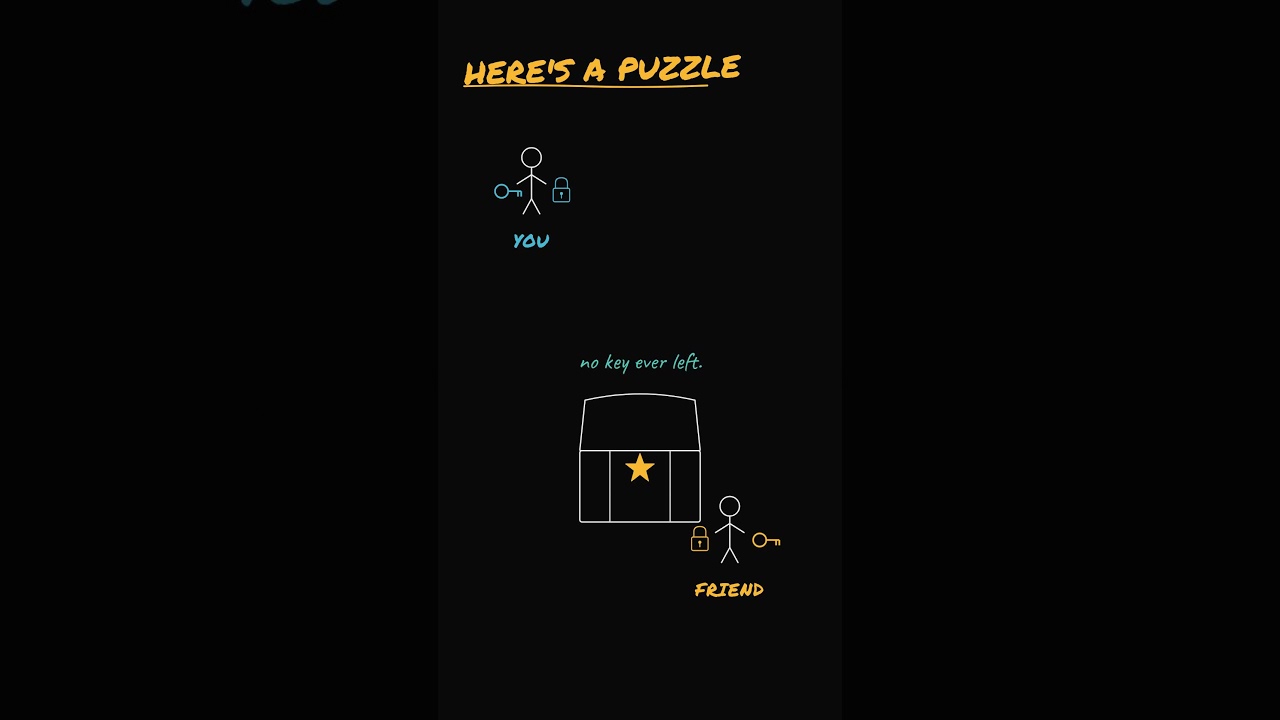
Imagine needing to send a valuable item in a trunk to a friend across enemy lines, but you cannot safely share a key. The solution is simple: you put your own lock on the trunk and ship it. Your friend receives it, adds their own lock, and sends it back to you. You then remove your original lock and ship it a final time. Now, only your friend's lock remains, and they can open it safely with their own key.
In cryptography, this is known as the three-pass protocol, replacing physical padlocks with mathematical encryption layers. You encrypt the data, your friend adds a second layer of encryption, you peel your original layer off, and your friend decrypts their own. For this to work, the math must be commutative, meaning the order of encryption and decryption doesn't matter. This proves that two total strangers can start a perfectly private conversation over an open network without ever exchanging a secret password beforehand.
box]
#Cryptography #CyberSecurity #SystemDesign #InfoSec #DataPrivacy #TechExplained #ComputerScience #Protocols #Mathematics #CodingTips #puzzle
Imagine needing to send a valuable item in a trunk to a friend across enemy lines, but you cannot safely share a key. The solution is simple: you put your own lock on the trunk and ship it. Your friend receives it, adds their own lock, and sends it back to you. You then remove your original lock and ship it a final time. Now, only your friend's lock remains, and they can open it safely with their own key.
In cryptography, this is known as the three-pass protocol, replacing physical padlocks with mathematical encryption layers. You encrypt the data, your friend adds a second layer of encryption, you peel your original layer off, and your friend decrypts their own. For this to work, the math must be commutative, meaning the order of encryption and decryption doesn't matter. This proves that two total strangers can start a perfectly private conversation over an open network without ever exchanging a secret password beforehand.
box]
#Cryptography #CyberSecurity #SystemDesign #InfoSec #DataPrivacy #TechExplained #ComputerScience #Protocols #Mathematics #CodingTips #puzzle

KodeKloud
...