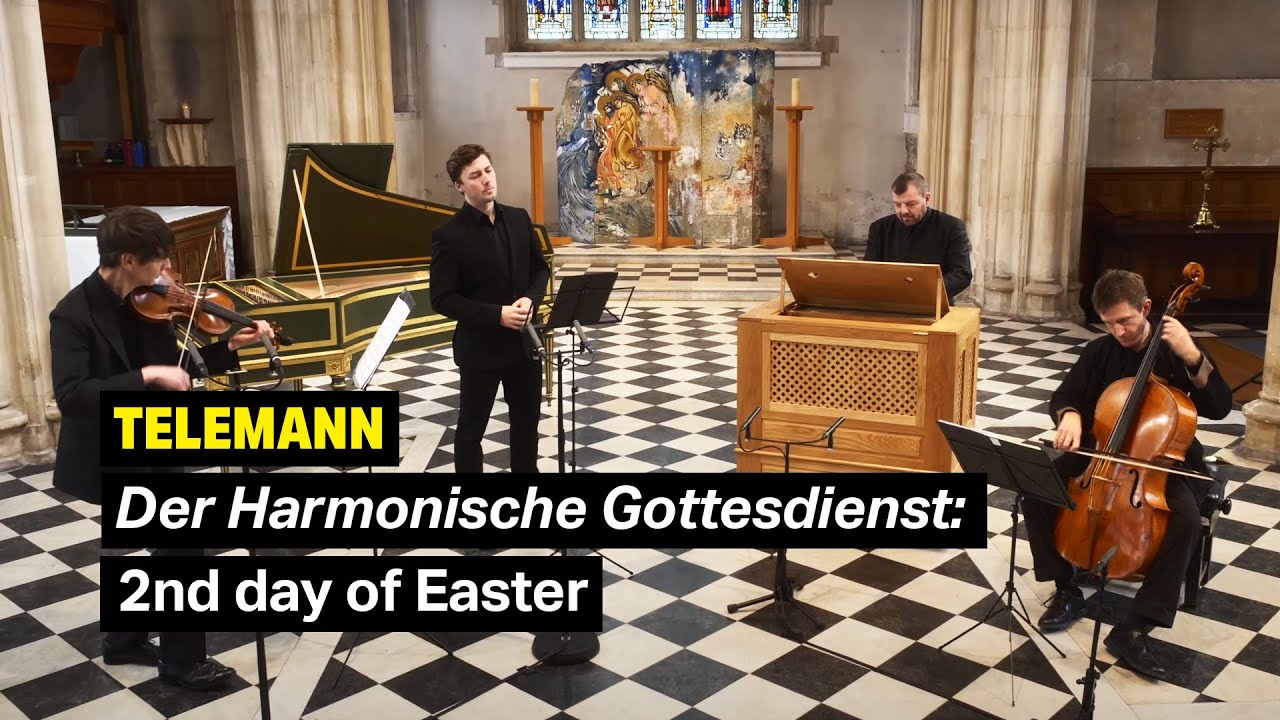
TELEMANN: Der Harmonische Gottesdienst for the Second day of Easter
Subscribe: https://www.youtube.com/channel/UCrHICovzXa3ePnfRqUV5wkQ
Join as a channel member! Support our channel and get access to exclusive content of full performances on historically authentic instruments: https://www.youtube.com/channel/UCrHICovzXa3ePnfRqUV5wkQ/join
Georg Philipp Telemann (1681-1767)
Der Harmonische Gottesdienst:
Second day of Easter ‘Triumphierendere Versöhner'
0:00 Aria
3:28 Recitative
5:52 Aria
12 cycles [of cantatas]; many long works with trumpets and timpani for high feast days, approximately 700 arias; 19 passions…6 for the mayors’ funerals; 12 for pastors’ initiations, 3 for jubilees...
And the list continues – even just reading the catalogue of his church music that Georg Philipp Telemann incorporated in his autobiography is sufficient to make the point. The life of a kantor (or music director) of a church in baroque Germany was a busy one: rehearsing, performing (and when necessary, composing) a continual supply of fresh, appropriate music for each Sunday and feast-day of the liturgical year.
Telemann realised that if he composed and published a year’s worth of short cantatas, he’d find an enthusiastic market among kantors desperate for new music. Der Harmonische Gottersdienst was published in 1726, and each of its 72 cantatas used just one singer, a solo instrumentalist and continuo. This is the cantata for Easter Monday: Christ has risen, and the mood is one of triumph and celebration. That would call for trumpets in a major church, but good trumpeters were in short supply and Telemann was mindful of his customers’ needs. So he pairs his singer instead with a solo violin which, from first note to last, seems to dance for joy.
Violin: Matthew Truscott
Cello: Jonathan Manson
Organ: Steven Devine
Baritone: Dominic Sedgwick
Audio Engineer: Ben Connellan
___
Website: http://oae.co.uk
Facebook: https://www.facebook.com/orchestraoftheageofenlightenment
Twitter: https://twitter.com/theoae
Instagram: https://www.instagram.com/orchestraoftheageenlightenment
Join as a channel member! Support our channel and get access to exclusive content of full performances on historically authentic instruments: https://www.youtube.com/channel/UCrHICovzXa3ePnfRqUV5wkQ/join
Georg Philipp Telemann (1681-1767)
Der Harmonische Gottesdienst:
Second day of Easter ‘Triumphierendere Versöhner'
0:00 Aria
3:28 Recitative
5:52 Aria
12 cycles [of cantatas]; many long works with trumpets and timpani for high feast days, approximately 700 arias; 19 passions…6 for the mayors’ funerals; 12 for pastors’ initiations, 3 for jubilees...
And the list continues – even just reading the catalogue of his church music that Georg Philipp Telemann incorporated in his autobiography is sufficient to make the point. The life of a kantor (or music director) of a church in baroque Germany was a busy one: rehearsing, performing (and when necessary, composing) a continual supply of fresh, appropriate music for each Sunday and feast-day of the liturgical year.
Telemann realised that if he composed and published a year’s worth of short cantatas, he’d find an enthusiastic market among kantors desperate for new music. Der Harmonische Gottersdienst was published in 1726, and each of its 72 cantatas used just one singer, a solo instrumentalist and continuo. This is the cantata for Easter Monday: Christ has risen, and the mood is one of triumph and celebration. That would call for trumpets in a major church, but good trumpeters were in short supply and Telemann was mindful of his customers’ needs. So he pairs his singer instead with a solo violin which, from first note to last, seems to dance for joy.
Violin: Matthew Truscott
Cello: Jonathan Manson
Organ: Steven Devine
Baritone: Dominic Sedgwick
Audio Engineer: Ben Connellan
___
Website: http://oae.co.uk
Facebook: https://www.facebook.com/orchestraoftheageofenlightenment
Twitter: https://twitter.com/theoae
Instagram: https://www.instagram.com/orchestraoftheageenlightenment

Orchestra of the Age of Enlightenment
Ok, it’s a not very snappy name, so we tend to call ourselves the OAE. The OAE is probably one of the top ‘period instrument’ Orchestras in the world. What does this mean? Well, over the years instruments and techniques have changed. We try to be authenti...