Privacy Amplification for Correlated-Noise Mechanisms via b-Min-Sep Subsampling
A Google TechTalk, 2026-02-18, presented by Andy Dong
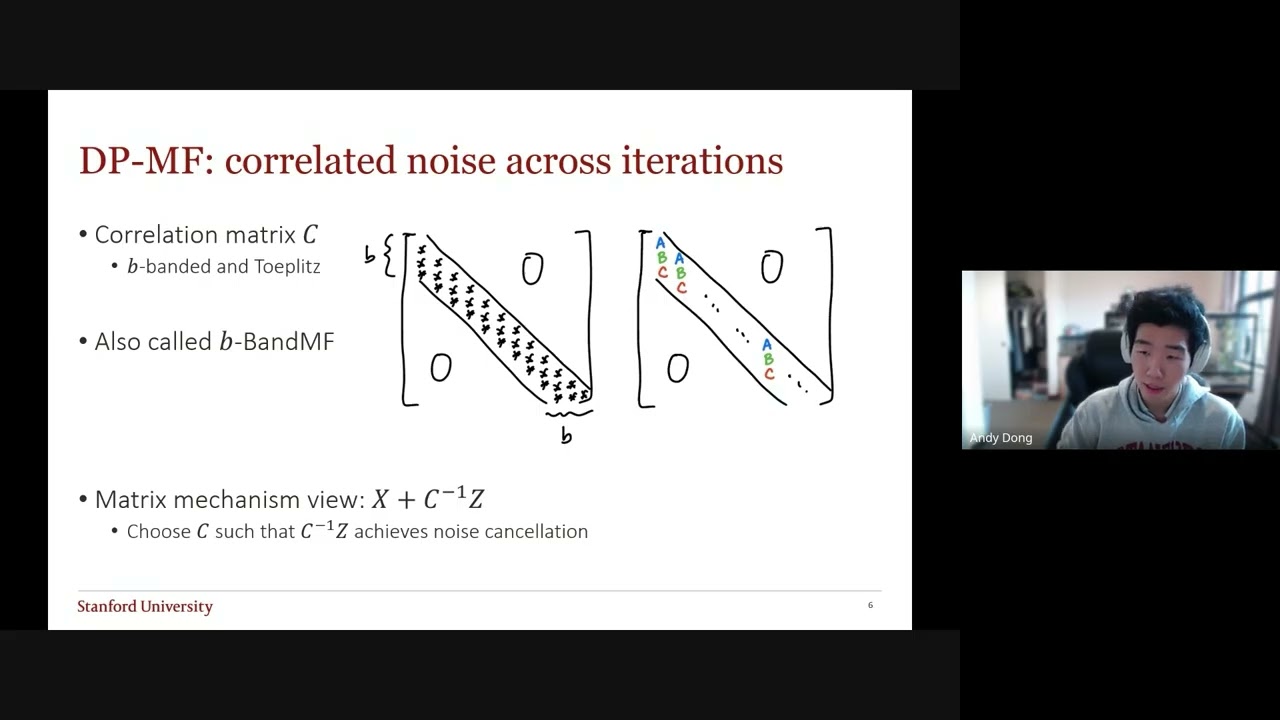
ABSTRACT: DP-SGD remains the standard approach for private model training. A variety of techniques have been developed to improve its privacy–utility tradeoff, including privacy amplification through data subsampling, leveraging structured randomness in the training process, and correlated-noise mechanisms such as DP matrix factorization (DP-MF). While DP-MF can improve utility, its interaction with subsampling-based amplification is less explored than in the classical DP-SGD setting.
In this talk, I present b-min-sep subsampling, a simple batching scheme for DP-MF. The key idea is to impose only a minimal participation constraint that preserves the structural properties required by correlated-noise mechanisms, while retaining substantial flexibility in sampling. The resulting scheme improves over cyclic Poisson subsampling and is a generalization of balls-in-bins subsampling.
I will give a high-level overview of the privacy analysis based on Monte Carlo accounting and dynamic programming, and present empirical results demonstrating improved privacy–utility tradeoffs in both example-level and multi-attribution user-level settings. More broadly, this work fits into a line of research on leveraging randomness in training for privacy amplification.
ABSTRACT: DP-SGD remains the standard approach for private model training. A variety of techniques have been developed to improve its privacy–utility tradeoff, including privacy amplification through data subsampling, leveraging structured randomness in the training process, and correlated-noise mechanisms such as DP matrix factorization (DP-MF). While DP-MF can improve utility, its interaction with subsampling-based amplification is less explored than in the classical DP-SGD setting.
In this talk, I present b-min-sep subsampling, a simple batching scheme for DP-MF. The key idea is to impose only a minimal participation constraint that preserves the structural properties required by correlated-noise mechanisms, while retaining substantial flexibility in sampling. The resulting scheme improves over cyclic Poisson subsampling and is a generalization of balls-in-bins subsampling.
I will give a high-level overview of the privacy analysis based on Monte Carlo accounting and dynamic programming, and present empirical results demonstrating improved privacy–utility tradeoffs in both example-level and multi-attribution user-level settings. More broadly, this work fits into a line of research on leveraging randomness in training for privacy amplification.

Google TechTalks
Google Tech Talks is a grass-roots program at Google for sharing information of interest to the technical community. At its best, it's part of an ongoing discussion about our world featuring top experts in diverse fields. Presentations range from the br...