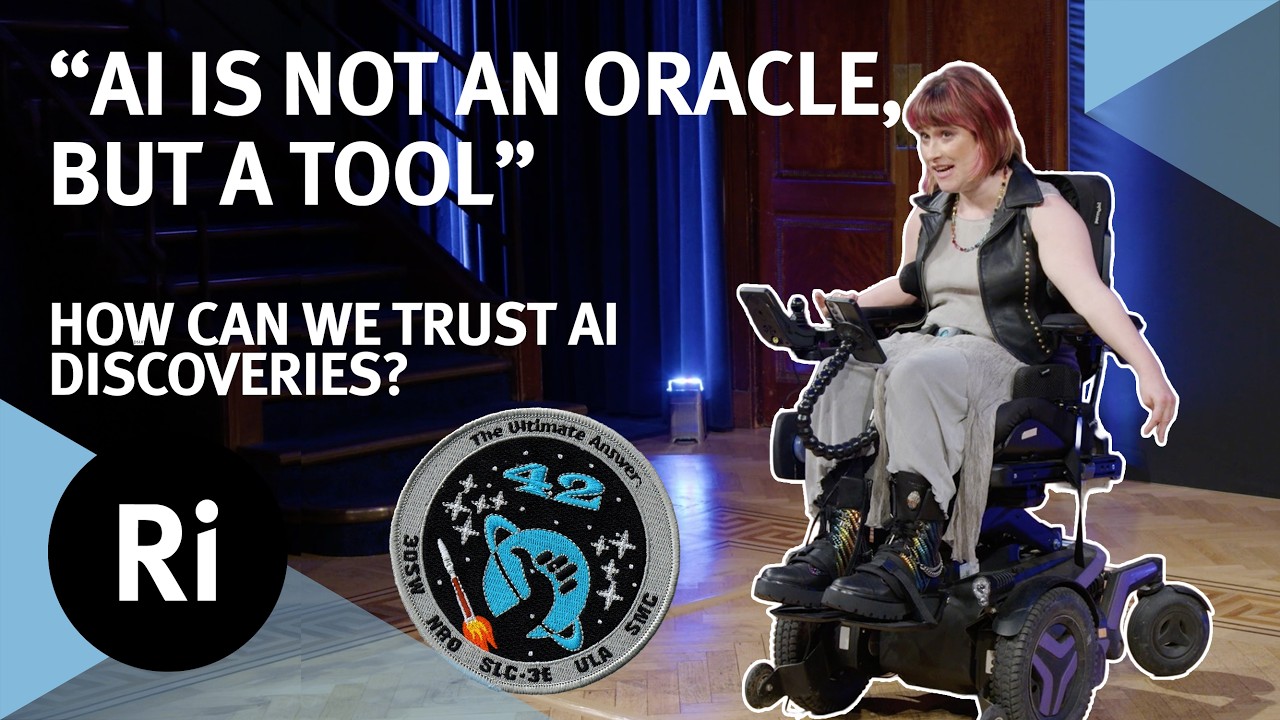
AI Is transforming science — but does it understand any of it? | with Claire Malone
What does it mean to make a scientific discovery — and can a machine really do it?
? Filmed at the Ri on 2 May 2026
AI is now simulating particle collisions at CERN, predicting protein structures that stumped biologists for decades, and proposing experiments that human researchers never thought to run. But here's the unsettling question underneath all of it: what if these systems are generating correct answers without understanding why those answers are true?
In this talk, particle physicist and science journalist Claire Malone cuts to the heart of one of the most pressing questions of our time. Drawing on her own experience at CERN — searching for supersymmetry at the world's most powerful particle accelerator — she unpacks how today's most advanced AI systems actually work, from the transformer architecture powering large language models like ChatGPT, to the generative diffusion models now being used to simulate the ATLAS detector at the Large Hadron Collider tens of times faster than traditional physics-based methods.
____
Subscribe to the Royal Institution for weekly talks from the world's leading scientists and thinkers ► http://bit.ly/RiSubscRibe
Become a Royal Institution member and support our work ► https://www.youtube.com/channel/UCYeF244yNGuFefuFKqxIAXw/join
____
Claire examines the philosophy that underpins science itself; from the Vienna Circle's demand for verifiability to Karl Popper's principle of falsification — asking whether systems that operate on statistical pattern-matching rather than causal understanding can ever truly meet those standards. With AlphaFold solving a 50-year problem in molecular biology and anomaly-detection algorithms at CERN flagging physics that our theories cannot yet explain, the stakes of these questions have never been higher.
Claire Malone is a science journalist based in London, a contributing columnist for Physics World, and the STEM Lead for the Lightyear Foundation. She holds a PhD in particle physics from the University of Cambridge, where her research focused on developing novel techniques to search for evidence of supersymmetry beyond the Standard Model. Her 2021 TED talk has been viewed nearly 2 million times.
___
The Royal Institution is a charity. Talks like this one exist because of the generosity of people who believe science should be accessible to everyone. If this video sparked something in you and you're in a position to give, a donation of any size makes a real difference ► https://rigb.my.site.com/membership/s/donate
___
Chapters:
0:00 Introduction: AI and the Future of Scientific Discovery
2:55 What Is Science? The Philosophy Behind the Method
8:06 How Machine Learning and AI Actually Work
16:22 How ChatGPT and Large Language Models Generate Text
24:13 AlphaFold: How AI Solved a 50-Year Biology Problem
30:33 How CERN Is Using AI to Analyse Particle Physics Data
37:27 The Nobel Turing Challenge: Can AI Win a Nobel Prize?
43:05 Why Current AI Can't Make True Scientific Discoveries
47:04 Is AI a Scientific Collaborator or Just a Powerful Tool?
___
The Ri is on Facebook: http://www.facebook.com/royalinstitution
and TikTok: https://www.tiktok.com/@ri_science
Listen to the Ri podcast: https://podcasters.spotify.com/pod/show/ri-science-podcast
Donate to the RI and help us bring you more lectures: https://www.rigb.org/support-us/donate-ri
Our editorial policy: https://www.rigb.org/editing-ri-talks-and-moderating-comments
Subscribe for the latest science videos: http://bit.ly/RiNewsletter
____
#AI #ArtificialIntelligence #MachineLearning #Science #CERN #ParticlePhysics #AlphaFold #GenerativeAI #LargeLanguageModels #ScientificDiscovery #DeepLearning #Physics #ChatGPT #royalinstitution
____
Product links on this page may be affiliate links which means it won't cost you any extra but we may earn a small commission if you decide to purchase through the link.
? Filmed at the Ri on 2 May 2026
AI is now simulating particle collisions at CERN, predicting protein structures that stumped biologists for decades, and proposing experiments that human researchers never thought to run. But here's the unsettling question underneath all of it: what if these systems are generating correct answers without understanding why those answers are true?
In this talk, particle physicist and science journalist Claire Malone cuts to the heart of one of the most pressing questions of our time. Drawing on her own experience at CERN — searching for supersymmetry at the world's most powerful particle accelerator — she unpacks how today's most advanced AI systems actually work, from the transformer architecture powering large language models like ChatGPT, to the generative diffusion models now being used to simulate the ATLAS detector at the Large Hadron Collider tens of times faster than traditional physics-based methods.
____
Subscribe to the Royal Institution for weekly talks from the world's leading scientists and thinkers ► http://bit.ly/RiSubscRibe
Become a Royal Institution member and support our work ► https://www.youtube.com/channel/UCYeF244yNGuFefuFKqxIAXw/join
____
Claire examines the philosophy that underpins science itself; from the Vienna Circle's demand for verifiability to Karl Popper's principle of falsification — asking whether systems that operate on statistical pattern-matching rather than causal understanding can ever truly meet those standards. With AlphaFold solving a 50-year problem in molecular biology and anomaly-detection algorithms at CERN flagging physics that our theories cannot yet explain, the stakes of these questions have never been higher.
Claire Malone is a science journalist based in London, a contributing columnist for Physics World, and the STEM Lead for the Lightyear Foundation. She holds a PhD in particle physics from the University of Cambridge, where her research focused on developing novel techniques to search for evidence of supersymmetry beyond the Standard Model. Her 2021 TED talk has been viewed nearly 2 million times.
___
The Royal Institution is a charity. Talks like this one exist because of the generosity of people who believe science should be accessible to everyone. If this video sparked something in you and you're in a position to give, a donation of any size makes a real difference ► https://rigb.my.site.com/membership/s/donate
___
Chapters:
0:00 Introduction: AI and the Future of Scientific Discovery
2:55 What Is Science? The Philosophy Behind the Method
8:06 How Machine Learning and AI Actually Work
16:22 How ChatGPT and Large Language Models Generate Text
24:13 AlphaFold: How AI Solved a 50-Year Biology Problem
30:33 How CERN Is Using AI to Analyse Particle Physics Data
37:27 The Nobel Turing Challenge: Can AI Win a Nobel Prize?
43:05 Why Current AI Can't Make True Scientific Discoveries
47:04 Is AI a Scientific Collaborator or Just a Powerful Tool?
___
The Ri is on Facebook: http://www.facebook.com/royalinstitution
and TikTok: https://www.tiktok.com/@ri_science
Listen to the Ri podcast: https://podcasters.spotify.com/pod/show/ri-science-podcast
Donate to the RI and help us bring you more lectures: https://www.rigb.org/support-us/donate-ri
Our editorial policy: https://www.rigb.org/editing-ri-talks-and-moderating-comments
Subscribe for the latest science videos: http://bit.ly/RiNewsletter
____
#AI #ArtificialIntelligence #MachineLearning #Science #CERN #ParticlePhysics #AlphaFold #GenerativeAI #LargeLanguageModels #ScientificDiscovery #DeepLearning #Physics #ChatGPT #royalinstitution
____
Product links on this page may be affiliate links which means it won't cost you any extra but we may earn a small commission if you decide to purchase through the link.

The Royal Institution
Videos to make you think more deeply about science. Explosive short films, full length talks from the world’s leading scientists and writers, and videos to challenge the way you look at the world.
The Royal Institution is a 200 year old independent chari...