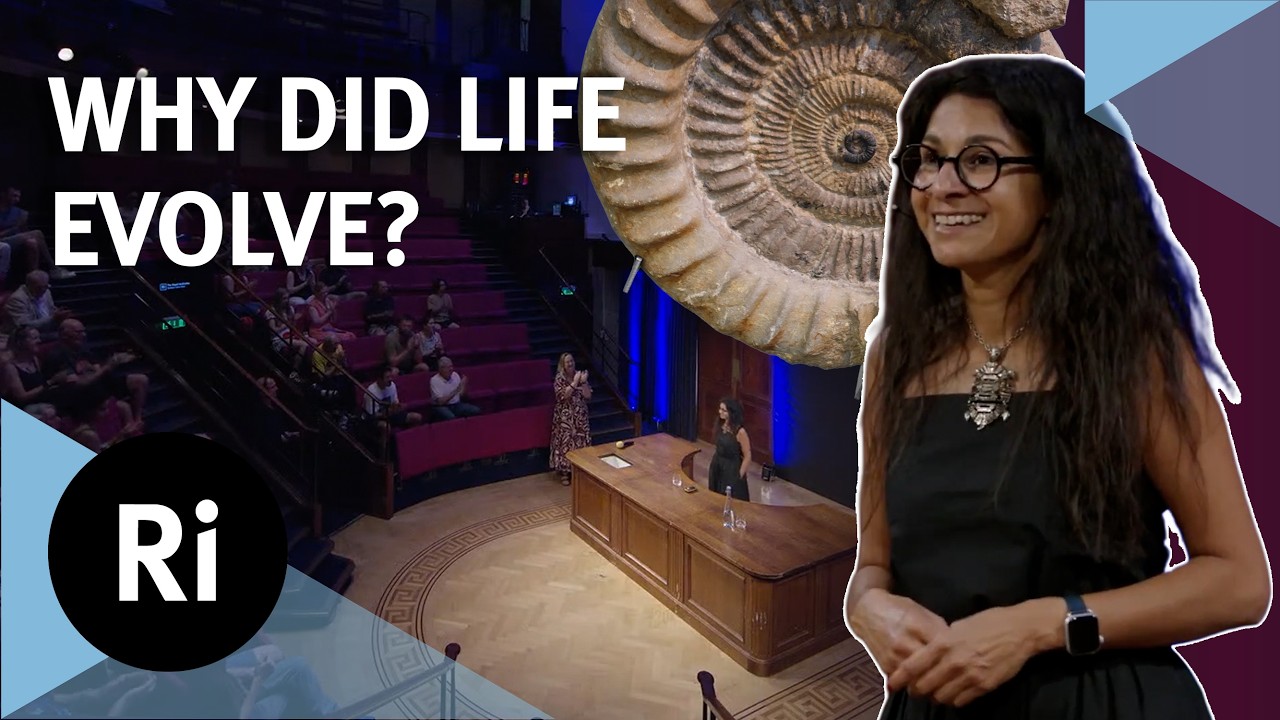
The hidden rule behind all evolution | with biologist Anjali Goswami
Why do cats look almost exactly the same as they did millions of years ago, while dogs have exploded into hundreds of wildly different shapes? Why are birds (the most diverse living dinosaurs) actually the slowest evolving dinosaurs of all? And why do the same body shapes keep evolving again and again, in completely unrelated animals, on opposite sides of the planet?
Evolutionary biologist Anjali Goswami has spent her career trying to answer one enormous question: why does life look the way it does? Using a technique she calls "evolutionary phenomics" - building vast 3D databases of skull shapes from thousands of species, living and extinct - she's uncovering the hidden rules that constrain evolution, the traits that lock species into their niches, and the surprising factors (from social structure to sleep patterns) that determine how fast a species can change.
This talk was filmed at the Royal Institution on 26 June 2026.
Goswami also explains how AI and automated imaging are now compressing years of painstaking fossil analysis into hours, opening up entire groups of animals, like insects and single-celled ocean organisms, that scientists could never study at this scale before. And she connects all of it to the urgent present: how fast species evolve in response to climate change, and what that tells us about the crisis of extinction happening right now.
_____________________________
Become a channel member to watch the exclusive Q&A and support the Ri in making more science content: https://www.youtube.com/channel/UCYeF244yNGuFefuFKqxIAXw/join
Subscribe for regular science videos: http://bit.ly/RiSubscRibe
_____________________________
Anjali Goswami is a research leader in evolutionary biology and former Dean of Postgraduate Education at the Natural History Museum, London. Since July 2025 she has been Chief Scientific Adviser at the Department for Environment, Food and Rural Affairs. Her fieldwork has taken her from Svalbard to Madagascar, with her primary research based in South India. She was elected a Fellow of the Royal Society in 2024.
_____________________________
Chapters:
00:00 Introduction
01:04 Why species diversity isn't evenly spread across the planet
04:54 What is "evolutionary phenomics"?
06:01 Why cats are the weirdest mammals alive
11:47 How diet and teeth trapped cats in one niche
15:22 The "fly in a tube": why most life forms never evolve
19:56 Convergent evolution: the Tasmanian tiger and the wolf
21:32 Why the past looked nothing like the present
23:35 Building 3D shape models — and automating it with AI
34:06 Scanning a million insects to solve a 200-year-old mystery
35:34 Birds, dinosaurs, and mammals: who evolves fastest?
44:04 Climate change, mass extinction, and what comes next
_____________________________
The Ri is on Facebook: http://www.facebook.com/royalinstitution
and TikTok: https://www.tiktok.com/@ri_science
Listen to the Ri podcast: https://podcasters.spotify.com/pod/show/ri-science-podcast
Donate to the RI and help us bring you more lectures: https://www.rigb.org/support-us/donate-ri
Our editorial policy: https://www.rigb.org/editing-ri-talks-and-moderating-comments
Subscribe for the latest science videos: http://bit.ly/RiNewsletter
Product links on this page may be affiliate links which means it won't cost you any extra but we may earn a small commission if you decide to purchase through the link.
#Evolution #Paleontology #RoyalInstitution #massextinction #biology #dinosaurs
Evolutionary biologist Anjali Goswami has spent her career trying to answer one enormous question: why does life look the way it does? Using a technique she calls "evolutionary phenomics" - building vast 3D databases of skull shapes from thousands of species, living and extinct - she's uncovering the hidden rules that constrain evolution, the traits that lock species into their niches, and the surprising factors (from social structure to sleep patterns) that determine how fast a species can change.
This talk was filmed at the Royal Institution on 26 June 2026.
Goswami also explains how AI and automated imaging are now compressing years of painstaking fossil analysis into hours, opening up entire groups of animals, like insects and single-celled ocean organisms, that scientists could never study at this scale before. And she connects all of it to the urgent present: how fast species evolve in response to climate change, and what that tells us about the crisis of extinction happening right now.
_____________________________
Become a channel member to watch the exclusive Q&A and support the Ri in making more science content: https://www.youtube.com/channel/UCYeF244yNGuFefuFKqxIAXw/join
Subscribe for regular science videos: http://bit.ly/RiSubscRibe
_____________________________
Anjali Goswami is a research leader in evolutionary biology and former Dean of Postgraduate Education at the Natural History Museum, London. Since July 2025 she has been Chief Scientific Adviser at the Department for Environment, Food and Rural Affairs. Her fieldwork has taken her from Svalbard to Madagascar, with her primary research based in South India. She was elected a Fellow of the Royal Society in 2024.
_____________________________
Chapters:
00:00 Introduction
01:04 Why species diversity isn't evenly spread across the planet
04:54 What is "evolutionary phenomics"?
06:01 Why cats are the weirdest mammals alive
11:47 How diet and teeth trapped cats in one niche
15:22 The "fly in a tube": why most life forms never evolve
19:56 Convergent evolution: the Tasmanian tiger and the wolf
21:32 Why the past looked nothing like the present
23:35 Building 3D shape models — and automating it with AI
34:06 Scanning a million insects to solve a 200-year-old mystery
35:34 Birds, dinosaurs, and mammals: who evolves fastest?
44:04 Climate change, mass extinction, and what comes next
_____________________________
The Ri is on Facebook: http://www.facebook.com/royalinstitution
and TikTok: https://www.tiktok.com/@ri_science
Listen to the Ri podcast: https://podcasters.spotify.com/pod/show/ri-science-podcast
Donate to the RI and help us bring you more lectures: https://www.rigb.org/support-us/donate-ri
Our editorial policy: https://www.rigb.org/editing-ri-talks-and-moderating-comments
Subscribe for the latest science videos: http://bit.ly/RiNewsletter
Product links on this page may be affiliate links which means it won't cost you any extra but we may earn a small commission if you decide to purchase through the link.
#Evolution #Paleontology #RoyalInstitution #massextinction #biology #dinosaurs

The Royal Institution
Videos to make you think more deeply about science. Explosive short films, full length talks from the world’s leading scientists and writers, and videos to challenge the way you look at the world.
The Royal Institution is a 200 year old independent chari...