System Design: Designing Load Balancer⚖️
How a Load Balancer Actually Splits Traffic!
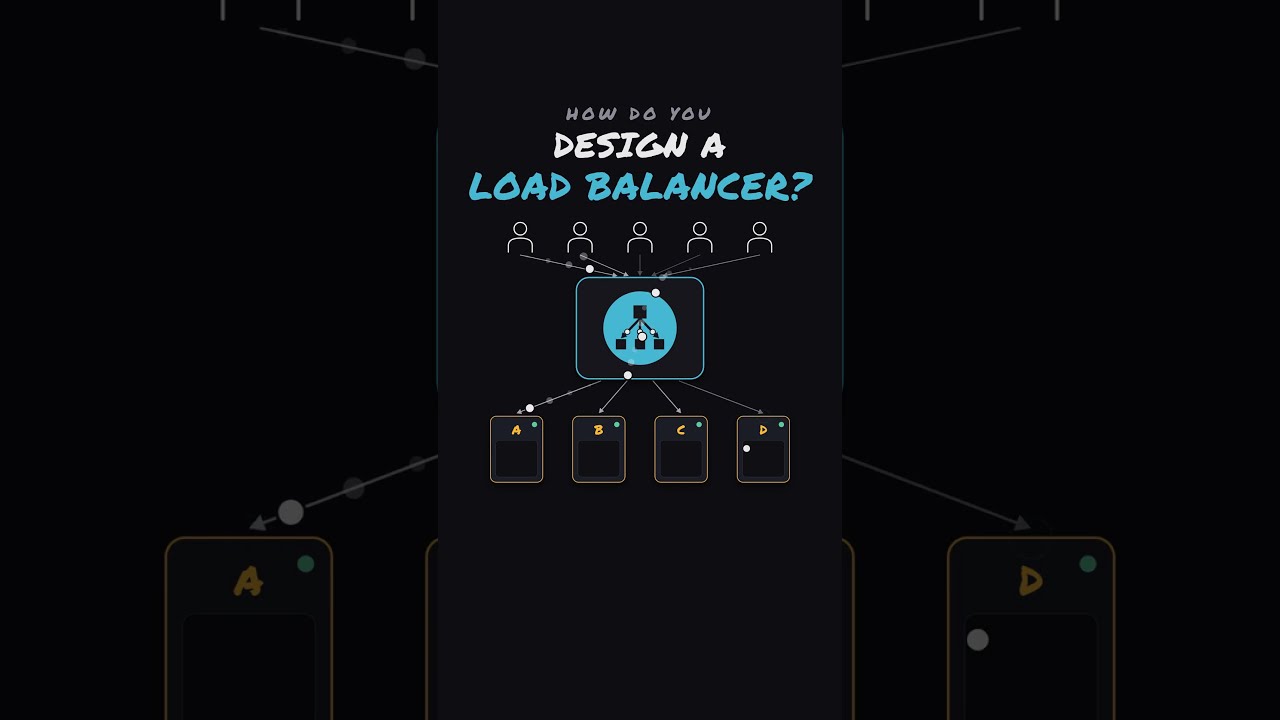
Round robin sends requests to servers A, B, C and D in a fixed loop, so it has no idea when one server is stuck on slow 2-second payment requests. Least connections fixes this by tracking how many requests each server is handling and sending the next one to the least busy server. The count is simple: add one when a request goes out, subtract one when the response comes back.
Health checks decide which servers stay in rotation. Passive checks watch real traffic and pause a server after a failed request. Active checks ping every server on a timer and mark it down after three misses in a row. NGINX gives you round robin by default, least connections with one line, and active health checks in NGINX Plus.
Round robin or least connections for your setup? Tell us in the comments.
#LoadBalancer #SystemDesign #NGINX #RoundRobin #LeastConnections #DevOps #BackendEngineering #HealthCheck #SystemDesignInterview #Scalability #CloudComputing #KodeKloud #Shorts
Round robin sends requests to servers A, B, C and D in a fixed loop, so it has no idea when one server is stuck on slow 2-second payment requests. Least connections fixes this by tracking how many requests each server is handling and sending the next one to the least busy server. The count is simple: add one when a request goes out, subtract one when the response comes back.
Health checks decide which servers stay in rotation. Passive checks watch real traffic and pause a server after a failed request. Active checks ping every server on a timer and mark it down after three misses in a row. NGINX gives you round robin by default, least connections with one line, and active health checks in NGINX Plus.
Round robin or least connections for your setup? Tell us in the comments.
#LoadBalancer #SystemDesign #NGINX #RoundRobin #LeastConnections #DevOps #BackendEngineering #HealthCheck #SystemDesignInterview #Scalability #CloudComputing #KodeKloud #Shorts

KodeKloud
...