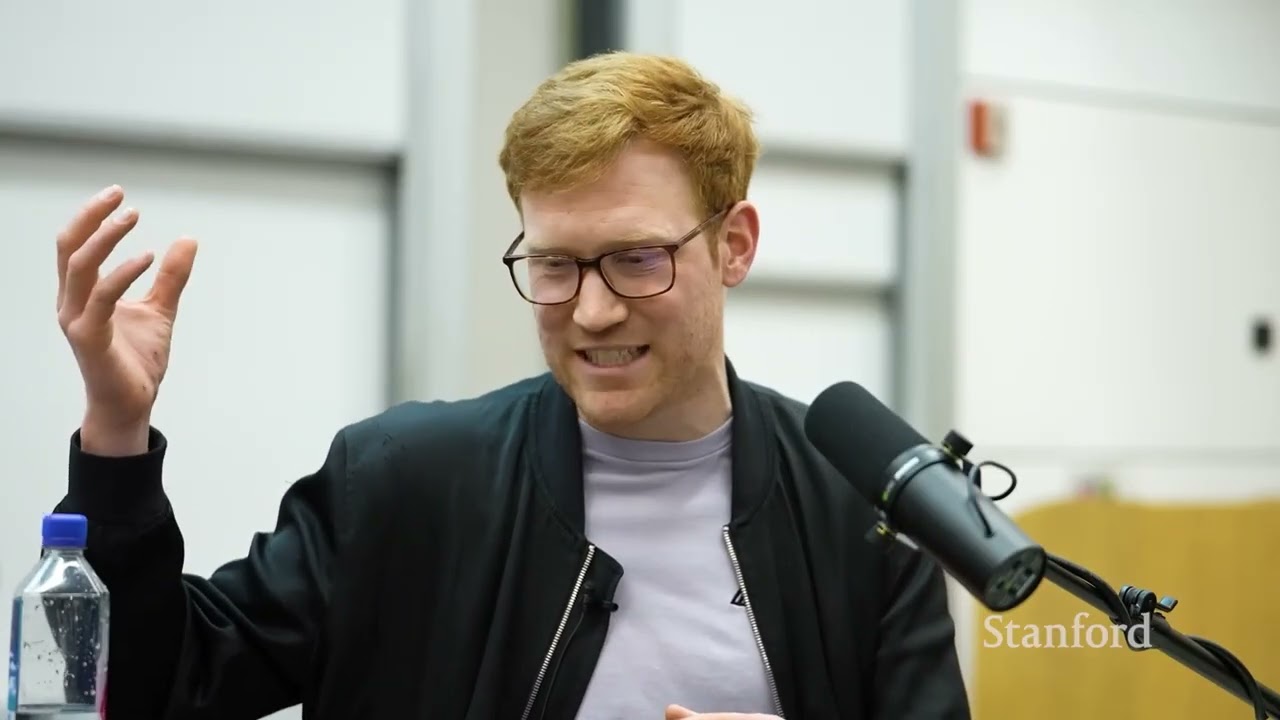
Stanford CS153 Frontier Systems | Andreas Blattmann from Black Forest Labs on Visual Intelligence
For more information about Stanford's online Artificial Intelligence programs, visit: https://stanford.io/ai
Follow along with the course schedule and syllabus, visit: https://cs153.stanford.edu/
In this CS153 “Frontier Systems” session, Anjney Midha welcomes Andreas Blattmann, co-founder of Black Forest Labs and co-creator of Stable Diffusion, for a discussion on the visual intelligence frontier and how frontier AI “factories” scale.
Blattmann recounts his path from mechanical engineering to a Heidelberg PhD lab, developing latent diffusion to train image generators efficiently and enabling Stable Diffusion’s 2022 release. They contrast earlier unimodal content-creation models with today’s push toward unified multimodal systems spanning images, video, and audio, plus action prediction for computer use and robotics, emphasizing observation and interaction loops.
Using Flux as a case study, they cover pre-training, mid-training, post-training, distillation for speed, customer feedback driving image editing and character consistency, and why open weights enable customization. They also discuss Self Flow for multimodal alignment, safety guardrails, EU compliance, data labeling strategies, diffusion vs autoregressive tradeoffs, and skepticism about explicit 3D representations.
Guest Speaker:
Andreas Blattmann is the co-founder of Black Forest Labs (BFL), the German generative AI startup behind the FLUX text-to-image foundation model, backed by Andreessen Horowitz and other major venture firms. Before founding BFL, he was a generative AI researcher at LMU Munich, NVIDIA, and Stability AI, where he made significant contributions to image and video generation. He is a co-inventor of Latent Diffusion, the generative modeling technique that produced the open-source text-to-image system Stable Diffusion (which he co-developed) and now powers cutting-edge models, including FLUX, Midjourney, and OpenAI's DALL-E 3, with applications extending into audio generation and medical imaging. His academic publications have amassed over 22,000 citations. He was named to Capital Magazin's Top 40 Under 40 in Germany in 2024.
Follow along with the course schedule and syllabus, visit: https://cs153.stanford.edu/
In this CS153 “Frontier Systems” session, Anjney Midha welcomes Andreas Blattmann, co-founder of Black Forest Labs and co-creator of Stable Diffusion, for a discussion on the visual intelligence frontier and how frontier AI “factories” scale.
Blattmann recounts his path from mechanical engineering to a Heidelberg PhD lab, developing latent diffusion to train image generators efficiently and enabling Stable Diffusion’s 2022 release. They contrast earlier unimodal content-creation models with today’s push toward unified multimodal systems spanning images, video, and audio, plus action prediction for computer use and robotics, emphasizing observation and interaction loops.
Using Flux as a case study, they cover pre-training, mid-training, post-training, distillation for speed, customer feedback driving image editing and character consistency, and why open weights enable customization. They also discuss Self Flow for multimodal alignment, safety guardrails, EU compliance, data labeling strategies, diffusion vs autoregressive tradeoffs, and skepticism about explicit 3D representations.
Guest Speaker:
Andreas Blattmann is the co-founder of Black Forest Labs (BFL), the German generative AI startup behind the FLUX text-to-image foundation model, backed by Andreessen Horowitz and other major venture firms. Before founding BFL, he was a generative AI researcher at LMU Munich, NVIDIA, and Stability AI, where he made significant contributions to image and video generation. He is a co-inventor of Latent Diffusion, the generative modeling technique that produced the open-source text-to-image system Stable Diffusion (which he co-developed) and now powers cutting-edge models, including FLUX, Midjourney, and OpenAI's DALL-E 3, with applications extending into audio generation and medical imaging. His academic publications have amassed over 22,000 citations. He was named to Capital Magazin's Top 40 Under 40 in Germany in 2024.

Stanford Online
You can gain access to a world of education through Stanford Online, the Stanford School of Engineering’s portal for academic and professional education offered by schools and units throughout Stanford University. https://online.stanford.edu/
Our robust ...
Stanford CS336 Language Modeling from Scratch | Spring 2026 | Lecture 12: Evaluation
Stanford Online
Stanford Online AI Programs Top Questions: Enrolling in Online Courses vs Self Study
Stanford Online
Stanford CS336 Language Modeling from Scratch | Spring 2026 | Lecture 8: Parallelism
Stanford Online
Stanford CS336 Language Modeling from Scratch | Spring 2026 | Lecture 7: Parallelism
Stanford Online