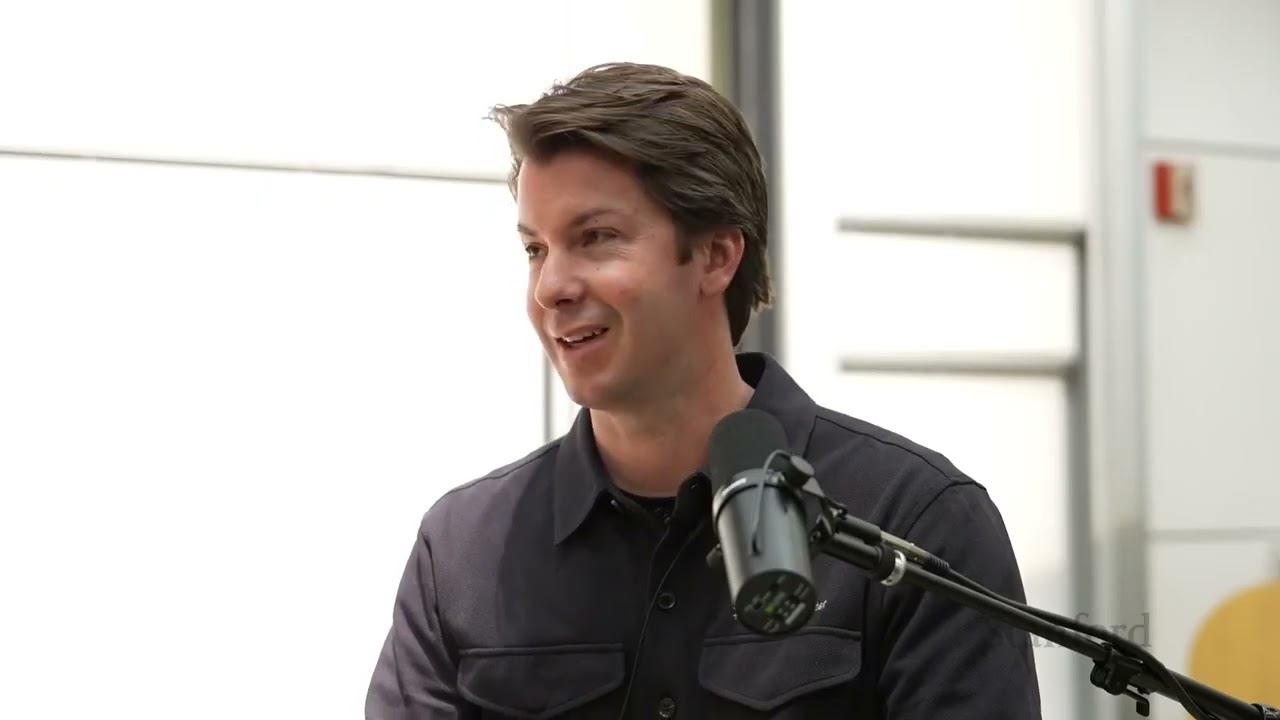
Stanford CS153 Frontier Systems | Scott Nolan from General Matter on Energy Bottlenecks
For more information about Stanford's online Artificial Intelligence programs, visit: https://stanford.io/ai
Follow along with the course schedule and syllabus, visit: https://cs153.stanford.edu/
In a CS153 Frontier Systems lecture, the class zooms out from AI model labs to examine energy and electricity as upstream bottlenecks to compute and data center growth, intensified since ChatGPT’s 2022 breakout and renewed enterprise demand after Claude 4.6.
Guest Scott Nolan, CEO of General Matter, argues that uptime requirements and turbine shortages make baseload power crucial, pushing hyperscalers toward nuclear for its low carbon emissions and safety record. He explains nuclear’s fuel supply chain and identifies uranium enrichment as the key missing U.S. capability, with the U.S. holding under 0.1% enrichment market share and relying on Europe and Russia. Nolan describes founding General Matter in 2024, winning a $900M DOE contract, building a Kentucky facility, and hiring toward hundreds to thousands of roles.
Guest Speaker:
Scott Nolan is the co-founder and CEO of General Matter, a company working to reshore U.S. uranium enrichment capabilities and revive American nuclear fuel production. He founded General Matter after spending over a year searching for an American enrichment company to invest in and finding none existed. General Matter is sometimes described as the third in a trilogy of companies incubated at Founders Fund, following Palantir and Anduril. He is also a Partner at Founders Fund (since 2011), where he focuses on companies rearchitecting industries — usually with hard engineering at the foundation. He works with mission-driven founders across biotech, crypto, energy, infrastructure, manufacturing, and transportation, including Synthego, Collective Health, Modern Animal, Branch, Nubank, and others. Prior to Founders Fund, he was an early employee at SpaceX, where he helped develop the Merlin and Draco propulsion systems used on the Falcon and Dragon vehicles and was responsible for the Dragon capsule's thermal and environmental subsystems. After SpaceX, he spent time at Bain & Company, evaluating potential investments and driving portfolio company strategy for private equity clients. He also previously worked as a Systems Engineer at Boeing. He serves on the boards of ISEE, Collective Health, Invisibly, and Synthego, and previously served as a Board Observer at Ayar Labs.
Follow the playlist: https://youtube.com/playlist?list=PLoROMvodv4rN447WKQ5oz_YdYbS74M5IA&si=DOJ5amlyRdyMJBhG
Follow along with the course schedule and syllabus, visit: https://cs153.stanford.edu/
In a CS153 Frontier Systems lecture, the class zooms out from AI model labs to examine energy and electricity as upstream bottlenecks to compute and data center growth, intensified since ChatGPT’s 2022 breakout and renewed enterprise demand after Claude 4.6.
Guest Scott Nolan, CEO of General Matter, argues that uptime requirements and turbine shortages make baseload power crucial, pushing hyperscalers toward nuclear for its low carbon emissions and safety record. He explains nuclear’s fuel supply chain and identifies uranium enrichment as the key missing U.S. capability, with the U.S. holding under 0.1% enrichment market share and relying on Europe and Russia. Nolan describes founding General Matter in 2024, winning a $900M DOE contract, building a Kentucky facility, and hiring toward hundreds to thousands of roles.
Guest Speaker:
Scott Nolan is the co-founder and CEO of General Matter, a company working to reshore U.S. uranium enrichment capabilities and revive American nuclear fuel production. He founded General Matter after spending over a year searching for an American enrichment company to invest in and finding none existed. General Matter is sometimes described as the third in a trilogy of companies incubated at Founders Fund, following Palantir and Anduril. He is also a Partner at Founders Fund (since 2011), where he focuses on companies rearchitecting industries — usually with hard engineering at the foundation. He works with mission-driven founders across biotech, crypto, energy, infrastructure, manufacturing, and transportation, including Synthego, Collective Health, Modern Animal, Branch, Nubank, and others. Prior to Founders Fund, he was an early employee at SpaceX, where he helped develop the Merlin and Draco propulsion systems used on the Falcon and Dragon vehicles and was responsible for the Dragon capsule's thermal and environmental subsystems. After SpaceX, he spent time at Bain & Company, evaluating potential investments and driving portfolio company strategy for private equity clients. He also previously worked as a Systems Engineer at Boeing. He serves on the boards of ISEE, Collective Health, Invisibly, and Synthego, and previously served as a Board Observer at Ayar Labs.
Follow the playlist: https://youtube.com/playlist?list=PLoROMvodv4rN447WKQ5oz_YdYbS74M5IA&si=DOJ5amlyRdyMJBhG

Stanford Online
You can gain access to a world of education through Stanford Online, the Stanford School of Engineering’s portal for academic and professional education offered by schools and units throughout Stanford University. https://online.stanford.edu/
Our robust ...
Stanford CS336 Language Modeling from Scratch | Spring 2026 | Lecture 12: Evaluation
Stanford Online
Stanford Online AI Programs Top Questions: Enrolling in Online Courses vs Self Study
Stanford Online
Stanford CS336 Language Modeling from Scratch | Spring 2026 | Lecture 8: Parallelism
Stanford Online
Stanford CS336 Language Modeling from Scratch | Spring 2026 | Lecture 7: Parallelism
Stanford Online