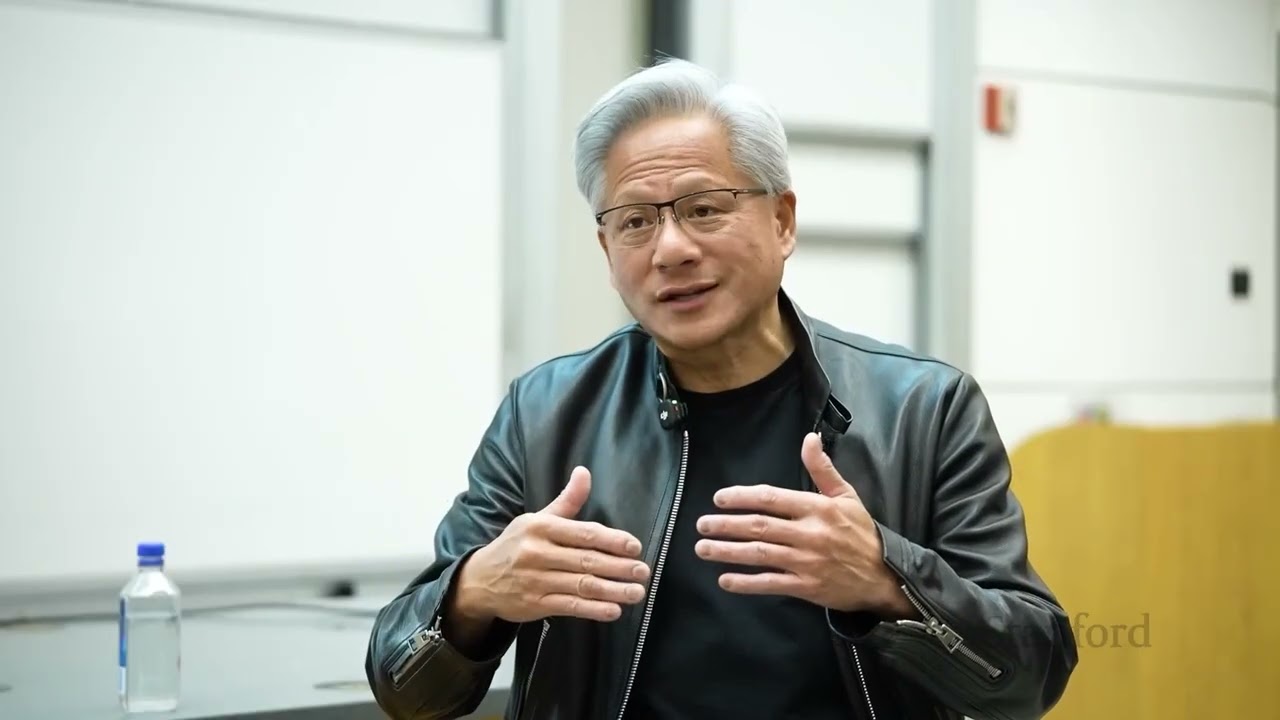
Stanford CS153 Frontier Systems | Jensen Huang from NVIDIA on the Compute Behind Intelligence
For more information about Stanford's online Artificial Intelligence programs, visit: https://stanford.io/ai
Follow along with the course schedule and syllabus, visit: https://cs153.stanford.edu/
In a CS153 Frontier Systems lecture, the class hosts Jensen Huang, CEO of NVIDIA, who argues computing is being reinvented for the first time in 64 years as software shifts from prerecorded execution to real-time generation, with NVIDIA's extreme co-design across chips, compilers, networks, and systems delivering a million-fold speedup over the past decade versus Moore's Law's 100x.
He walks through the architectural logic of Hopper (pre-training), Grace Blackwell NVLink72 (inference and decode), Vera Rubin (agents), and the upcoming Feynman generation built for swarms of agents and sub-agents, while pushing back on MFU as a misleading metric in favor of tokens-per-watt and real evals.
Huang also defends open models like Nemotron, BioNemo, and Alpamayo as essential for safety, transparency, and democratizing AI across underserved languages and scientific domains, and forecasts compute energy demand growing roughly a thousandfold, making this the strongest market moment in history to invest in sustainable energy and grid upgrades.
Guest Speaker:
Jensen Huang founded NVIDIA in 1993 and has served since its inception as president, chief executive officer, and a member of the board of directors.
Since its founding, NVIDIA has pioneered accelerated computing. The company’s invention of the GPU in 1999 sparked the growth of the PC gaming market, redefined computer graphics, and ignited the era of modern AI. NVIDIA is now driving the platform shift of accelerated computing and generative AI, transforming the world's largest industries and profoundly impacting society.
Huang has been elected to the National Academy of Engineering and in 2026 was appointed to the President’s Council of Advisors on Science and Technology. He is a recipient of the Semiconductor Industry Association’s highest honor, the Robert N. Noyce Award; the IEEE Founder’s Medal; the Dr. Morris Chang Exemplary Leadership Award; and honorary doctorate degrees from Taiwan’s National Chiao Tung University, National Taiwan University, Oregon State University, Huazhong University of Science and Technology, and Linköping University. He has been named the world’s best CEO by Fortune, the Economist, and Brand Finance, as well as one of TIME magazine’s 100 most influential people.
Prior to founding NVIDIA, Huang worked at LSI Logic and Advanced Micro Devices. He holds a BSEE degree from Oregon State University and an MSEE degree from Stanford University.
Follow the playlist: https://youtube.com/playlist?list=PLoROMvodv4rN447WKQ5oz_YdYbS74M5IA&si=DOJ5amlyRdyMJBhG
Follow along with the course schedule and syllabus, visit: https://cs153.stanford.edu/
In a CS153 Frontier Systems lecture, the class hosts Jensen Huang, CEO of NVIDIA, who argues computing is being reinvented for the first time in 64 years as software shifts from prerecorded execution to real-time generation, with NVIDIA's extreme co-design across chips, compilers, networks, and systems delivering a million-fold speedup over the past decade versus Moore's Law's 100x.
He walks through the architectural logic of Hopper (pre-training), Grace Blackwell NVLink72 (inference and decode), Vera Rubin (agents), and the upcoming Feynman generation built for swarms of agents and sub-agents, while pushing back on MFU as a misleading metric in favor of tokens-per-watt and real evals.
Huang also defends open models like Nemotron, BioNemo, and Alpamayo as essential for safety, transparency, and democratizing AI across underserved languages and scientific domains, and forecasts compute energy demand growing roughly a thousandfold, making this the strongest market moment in history to invest in sustainable energy and grid upgrades.
Guest Speaker:
Jensen Huang founded NVIDIA in 1993 and has served since its inception as president, chief executive officer, and a member of the board of directors.
Since its founding, NVIDIA has pioneered accelerated computing. The company’s invention of the GPU in 1999 sparked the growth of the PC gaming market, redefined computer graphics, and ignited the era of modern AI. NVIDIA is now driving the platform shift of accelerated computing and generative AI, transforming the world's largest industries and profoundly impacting society.
Huang has been elected to the National Academy of Engineering and in 2026 was appointed to the President’s Council of Advisors on Science and Technology. He is a recipient of the Semiconductor Industry Association’s highest honor, the Robert N. Noyce Award; the IEEE Founder’s Medal; the Dr. Morris Chang Exemplary Leadership Award; and honorary doctorate degrees from Taiwan’s National Chiao Tung University, National Taiwan University, Oregon State University, Huazhong University of Science and Technology, and Linköping University. He has been named the world’s best CEO by Fortune, the Economist, and Brand Finance, as well as one of TIME magazine’s 100 most influential people.
Prior to founding NVIDIA, Huang worked at LSI Logic and Advanced Micro Devices. He holds a BSEE degree from Oregon State University and an MSEE degree from Stanford University.
Follow the playlist: https://youtube.com/playlist?list=PLoROMvodv4rN447WKQ5oz_YdYbS74M5IA&si=DOJ5amlyRdyMJBhG

Stanford Online
You can gain access to a world of education through Stanford Online, the Stanford School of Engineering’s portal for academic and professional education offered by schools and units throughout Stanford University. https://online.stanford.edu/
Our robust ...
Stanford CS336 Language Modeling from Scratch | Spring 2026 | Lecture 12: Evaluation
Stanford Online
Stanford Online AI Programs Top Questions: Enrolling in Online Courses vs Self Study
Stanford Online
Stanford CS336 Language Modeling from Scratch | Spring 2026 | Lecture 8: Parallelism
Stanford Online
Stanford CS336 Language Modeling from Scratch | Spring 2026 | Lecture 7: Parallelism
Stanford Online