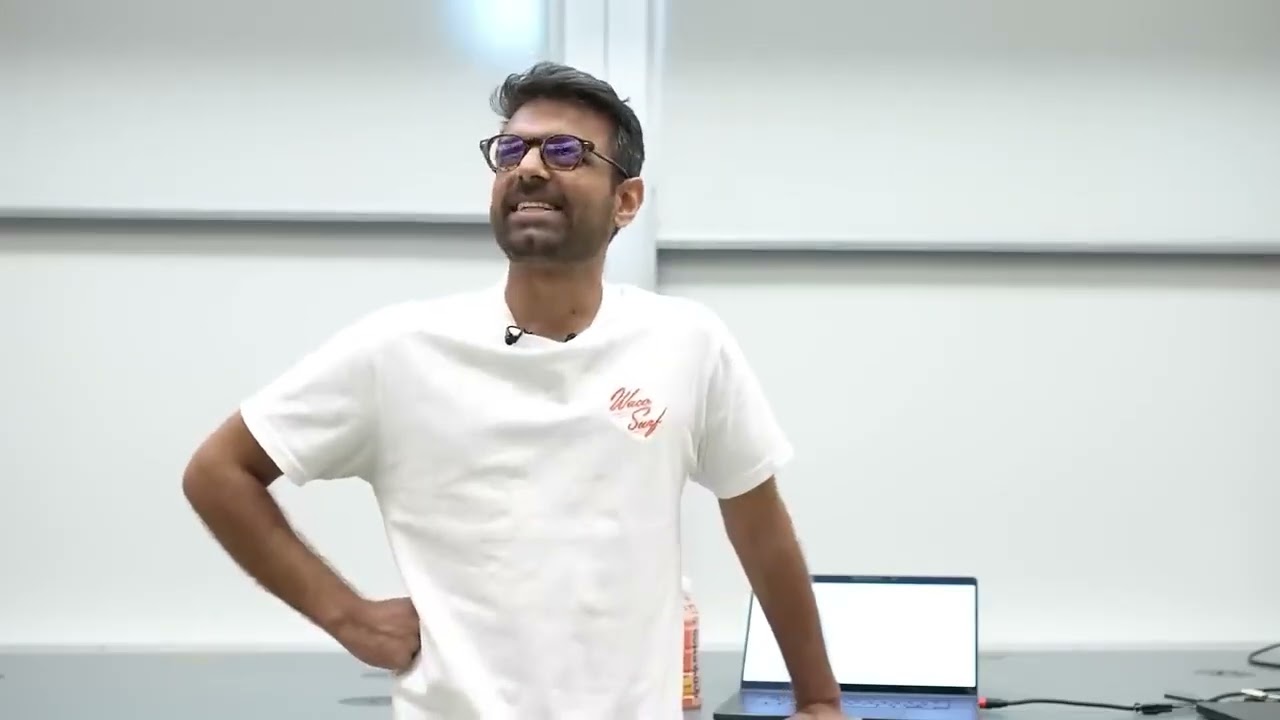
Stanford CS153 Frontier Systems | Anjney Midha from AMP PBC on Frontier Systems
For more information about Stanford's online Artificial Intelligence programs, visit: https://stanford.io/ai
Follow along with the course schedule and syllabus, visit: https://cs153.stanford.edu/
Anjney Midha opens the quarter of Stanford’s CS 153 Frontier Systems by framing the course as a speaker-led “AI Coachella,” emphasizing relationships, fun, and “obsessing over what you love” as a life heuristic.
He introduces his background and the course goal of real-world preparedness, then outlines the modern AI stack from capital and data centers through chips, cloud, models, applications, and governance. Midha reviews how AI development has industrialized—especially reinforcement learning and continuous post-training—and argues that “context” and verifiable feedback loops determine where progress accelerates and where value accrues, citing examples like IDE access conflicts and sovereign AI needs.
He then deep-dives on compute infrastructure, showing how capabilities and revenue correlate with compute buildouts, why GPU prices can rise, how infrastructure cycles resemble past commodity booms, and why compute remains non-fungible without standards and institutions.
About the speaker:
Anjney Midha is the founder of AMP PBC. Most recently, Anjney was General Partner at Andreessen Horowitz, leading frontier AI investments and Oxygen, the firm’s compute program. He serves on the boards of Mistral, Black Forest Labs, Sesame, LMArena, OpenRouter, Luma AI and Periodic Labs. He is a founding investor in Anthropic, and early angel in ElevenLabs among many other leading AI teams. Prior, Anj was the cofounder/CEO of Ubiquity6 (acquired by Discord) and a partner at Kleiner Perkins. Anj is a graduate of Stanford, where he remains a Visiting Scientist in the Applied Physics department and co-teaches CS 153, a systems at scale class.
Follow along with the course schedule and syllabus, visit: https://cs153.stanford.edu/
Anjney Midha opens the quarter of Stanford’s CS 153 Frontier Systems by framing the course as a speaker-led “AI Coachella,” emphasizing relationships, fun, and “obsessing over what you love” as a life heuristic.
He introduces his background and the course goal of real-world preparedness, then outlines the modern AI stack from capital and data centers through chips, cloud, models, applications, and governance. Midha reviews how AI development has industrialized—especially reinforcement learning and continuous post-training—and argues that “context” and verifiable feedback loops determine where progress accelerates and where value accrues, citing examples like IDE access conflicts and sovereign AI needs.
He then deep-dives on compute infrastructure, showing how capabilities and revenue correlate with compute buildouts, why GPU prices can rise, how infrastructure cycles resemble past commodity booms, and why compute remains non-fungible without standards and institutions.
About the speaker:
Anjney Midha is the founder of AMP PBC. Most recently, Anjney was General Partner at Andreessen Horowitz, leading frontier AI investments and Oxygen, the firm’s compute program. He serves on the boards of Mistral, Black Forest Labs, Sesame, LMArena, OpenRouter, Luma AI and Periodic Labs. He is a founding investor in Anthropic, and early angel in ElevenLabs among many other leading AI teams. Prior, Anj was the cofounder/CEO of Ubiquity6 (acquired by Discord) and a partner at Kleiner Perkins. Anj is a graduate of Stanford, where he remains a Visiting Scientist in the Applied Physics department and co-teaches CS 153, a systems at scale class.

Stanford Online
You can gain access to a world of education through Stanford Online, the Stanford School of Engineering’s portal for academic and professional education offered by schools and units throughout Stanford University. https://online.stanford.edu/
Our robust ...
Stanford CS336 Language Modeling from Scratch | Spring 2026 | Lecture 12: Evaluation
Stanford Online
Stanford Online AI Programs Top Questions: Enrolling in Online Courses vs Self Study
Stanford Online
Stanford CS336 Language Modeling from Scratch | Spring 2026 | Lecture 8: Parallelism
Stanford Online
Stanford CS336 Language Modeling from Scratch | Spring 2026 | Lecture 7: Parallelism
Stanford Online